Smashing the Idol of the Party: An Anarchist Vision for a Free Uganda
Kampala— In the sweltering heat of Ugandan politics, where the rhetoric of revolution is sold like cheap second-hand clothes, a familiar drama unfolds. The recent very public meltdown over National Unity Platform (NUP) denying one of its foot soldiers, Saudah Madaada, a party flag is not a tragedy. It is a farce. It is a meticulously staged performance by a parasitic class of political actors who feed on the genuine suffering of the masses while ensuring the oppressive state machinery remains unchallenged. From the comfortable exile of Germany, Stella Nyanzi pens tear-stained eulogies for a lost uterus and a denied nomination, performing a theatre of grief that obscures a simple, brutal truth: the opposition in Uganda is not a vehicle for liberation; it is a rival gang fighting for control of the same exploitative system. This is not a struggle for the people; it is a squabble among the bourgeoisie for a seat at the table of power.
An anarchist analysis tears away the veil of political party propaganda to reveal the raw class interests beneath. The following twenty points deconstruct this spectacle, exposing the NUP, its critics, and the entire opposition circus as sideshows that ultimately reinforce the dictatorship of Yoweri Museveni by perpetuating the myth that change can come from within the very structures designed to prevent it.
The recent political melodrama surrounding the National Unity Platform’s (NUP) denial of a party flag to activist Saudah Madaada has captivated Uganda’s opposition space, prompting outrage and heartfelt commentary from figures like Stella Nyanzi. Yet, beneath the performance of personal betrayal and tears lies a far more profound and unsettling truth: this spectacle is a deliberate distraction, masking a fundamental ideological bankruptcy. This analysis offers a radical anarchist critique of Uganda’s political opposition, arguing that parties like the NUP and the Forum for Democratic Change (FDC) are not vehicles for liberation but rival gangs competing to manage the same oppressive state apparatus.

Moving beyond the hollow slogan of “Remove Museveni,” we deconstruct the cult of personality around figures like Bobi Wine, the weaponisation of identity, and the dangerous myth of the “good leader.” We expose how the opposition’s internal squabbles over flags and nominations—a modern-day Frankfurt Parliament syndrome—serve only to demobilise popular anger and reinforce the state’s strategy of managed dissent. Ultimately, this critique contends that true liberation for Uganda will not be found in the ballot box or the headquarters of any political party. It will be forged through the silent, relentless work of building dual power: creating autonomous community assemblies (Olukiiko lwa Bantu), workers’ syndicates, and networks of mutual aid that operate completely outside the control of the state and its parasitic elites. This is a call to move from the politics of victimhood to the praxis of direct action, and to finally smash the idol of the party for good.
Twenty Points of Anarchist Critique: The Anatomy of a Political Scam
The Big Man’s Shadow: How Personality Cults Steal Uganda’s Revolution
In the political landscape of Uganda, a deeply ingrained proverb often dictates public life: “A tree cannot make a forest.” This wisdom speaks to the inherent power of community, collective action, and mutual reliance. Yet, the nation’s opposition politics, mirroring the very regime it claims to oppose, operates in direct contradiction to this truth. It has fervently embraced the cult of the personality, where the struggle for liberation is shrunk from a vast, collective endeavour into the personal brand of a handful of celebrated individuals—Bobi Wine, Stella Nyanzi, Kizza Besigye, and, in the recent melodrama, Saudah Madaada.


From an anarchist perspective, rooted in a fundamental mistrust of hierarchical power and a belief in the capacity of self-organised masses, this is not merely a strategic misstep; it is the very mechanism that neuters genuine revolution and keeps the populace chained to the idea that salvation must come from a saviour.
The Anatomy of the Personality Cult in Uganda
The commodification of the struggle, as seen in the recent NUP card saga, functions through several interconnected processes:
The Reduction of Complex Struggle to Personal Narrative: The multifaceted fight against a decades-old dictatorship—encompassing economic justice, land rights, ethnic favouritism, and police brutality—is simplified into the personal story of a leader. Bobi Wine is the “ghetto president,” Besigye is the “defiant doctor,” Nyanzi is the “radical feminist,” and Madaada is the “wronged foot soldier.” Their individual sufferings and triumphs become the primary storyline, overshadowing the systemic analysis of state power. The system itself, which should be the target, fades into the background, and the fight becomes about replacing the individuals in charge of that system, not dismantling it.
The Creation of a Consumerist Resistance: When the struggle is a brand, supporters become consumers. Instead of actively being the revolution through direct action, community organising, and workplace syndicates, the people are encouraged to support the revolution. This means buying branded merchandise (NUP’s Red berets and T-shirts), streaming the leader’s music, attending their rallies, and voting for them. Participation is passive and transactional. The energy that could be used to build autonomous people’s power is instead funneled into elevating a single figure, making the movement vulnerable to co-option, corruption, and, as seen with Madaada, devastating disillusionment when the leader fails to deliver.
The Illusion of Centralised Infallibility: The cult of personality demands that all strategy, wisdom, and direction flow from the top down. The leader’s word becomes final. This stifles critical thought, local initiative, and horizontal organising—the very bedrock of a resilient revolutionary movement. If the leader is arrested, exiled, or compromised, the entire movement risks paralysis. This creates a perfect mirror of the Museveni regime it opposes, which is also utterly dependent on one man. An anarchist approach argues that true strength lies in a thousand decentralised centres of power that cannot be decapitated by a single arrest.
The Erasure of the Masses: The most pernicious effect is the psychological disempowerment of the ordinary Ugandan. The message, repeated daily, is: “We need them to save us.” The countless acts of everyday resistance—the market vendor refusing to pay a bribe, the farmer defending his land from grabbers, the student organising a secret study group on political theory—are rendered invisible. The narrative suggests that until a famous leader from Kampala shows up, no real resistance is happening. This robs people of their agency and their belief in their own power, making them perpetual audience members in their own liberation story.
The Anarchist Alternative: From Leaders to Facilitators
Anarchism does not propose a leaderless void, but a society of different leaders. It distinguishes between power-over (coercive, hierarchical authority) and power-with (the influence and expertise one offers to a collective voluntarily).
 The alternative to the cult of personality is not no organisation, but self-organisation. Imagine, instead of a single NUP headquarters deciding who gets a flag in Arua or Gulu:
Community Assemblies: Residents of a village or neighbourhood gathering in a town meeting to discuss their specific needs and directly mandate a recallable delegate to represent those needs in a larger federation.
Workers’ Syndicates: Unions and cooperatives that manage their workplaces and resources collectively, building economic power from the ground up that is independent of both the state and opposition party patronage.
Popular Militias: Community-based self-defence networks, accountable to the community they protect, rather than a national army or police force designed to control the population.
In this model, a figure like Bobi Wine would not be a ‘President-in-waiting’ but a potent facilitator—using his platform to amplify the decisions of these assemblies, his music to spread their messages, and his resources to support their autonomously determined projects. His role would be to make himself obsolete, not indispensable.
Conclusion: The Forest is Stronger Than the Tree
The bitter tears shed over Saudah Madaada’s denied nomination are the inevitable result of betting the entire future of a nation on the whims of a centralised political party. The cult of personality is a poison that convinces the forest it cannot survive without one towering tree.
The ancient Ugandan adage holds the cure: “A tree cannot make a forest.” True revolutionary power does not reside in a person, a party, or a parliament. It resides in the collective will, intelligence, and courage of the self-organised masses. The task is not to find a better Big Man to lead us, but to finally realise that we are the forest, and we have been strong enough all along. The struggle for a free Uganda will be won not by following a single figure out of the wilderness, but by the people building a new world together, from the ground up, without permission from any leader.
The Golden Ticket: How the Quest for the Party Card Betrays Uganda’s Liberation
In Uganda, the political opposition often speaks of a singular goal: “Kisanja hakuna mchezo” (In the arena, there is no game). This adage, borrowed from the world of struggle, is meant to convey seriousness and high stakes. Yet, in a cruel irony, the opposition itself has turned the most serious of endeavours—the liberation of a people—into the most elaborate of games. The ultimate prize? Not the dismantling of the oppressive state apparatus, but the acquisition of a ‘party card’ or ‘flag’ from organisations like the National Unity Platform (NUP). This intense, all-consuming focus on who gets the nomination reveals a profound ideological bankruptcy. From an anarchist perspective, it represents the ultimate capitulation: the reduction of liberation to a mere candidacy within the state’s own rigged framework, a system meticulously designed by and for the ruling class to legitimise its power.
The State’s Game: Why Elections are a Trap
To understand the illusion, one must first understand the architect of the game. The Ugandan state, under the National Resistance Movement (NRM), is not a neutral playing field. It is a weapon.
A System Designed to Legitimise, Not Change: The electoral framework—with its biased Electoral Commission, its state-sponsored violence, and its patronage networks—is not a pathway to power for the oppressed. It is a pressure valve. It allows for managed dissent, creating the illusion of choice and participation, while ensuring the fundamental pillars of the regime remain untouched. Winning a seat within this system does not grant power to change it; it grants a title that legitimises the system itself. The new MP, however radical their intentions, is immediately absorbed into the logic of the institution, forced to play by its rules or be rendered irrelevant.
The Commodification of Revolution: The struggle against dictatorship is transformed into a crude transaction. The ‘party card’ becomes a commodity, the ultimate reward for loyalty and suffering. The recent spectacle surrounding Saudah Madaada is a perfect example: her torture in Arua and personal sacrifices were presented as a down payment on a future nomination. When the card was denied, it was framed as a bounced cheque, a personal betrayal. This dynamic reduces principled resistance to a form of careerist investment, where the goal is not to abolish the system but to secure a lucrative position within it.
‘People Power’ Becomes ‘Party Power’: The NUP’s original moniker, ‘People Power,’ was a powerful anarchistic concept—it suggested that power emanates from the people themselves, organised horizontally. However, by funneling this energy into a conventional political party structure, this power was quickly centralised and verticalised. ‘People Power’ now means the power of the people to elect NUP leaders to do things for them. The party becomes a gatekeeper, not a facilitator. The vibrant, decentralised energy of protest is bottled up and controlled by a central committee whose primary function is to distribute candidacies, thereby deciding who is and isn’t a ‘true’ revolutionary.
The Anarchist Critique: Liberation Beyond the Ballot Box
Anarchism argues that true liberation cannot be found on a ballot paper designed by your oppressor. Its critique is rooted in a fundamental rejection of the state as an institution of hierarchical, coercive control.
The State is the Problem, Not the Solution: The anarchist position is that the Ugandan state—a centralised, militarised, and corrupt entity built on colonial foundations—is inherently oppressive. Its purpose is to maintain the class interests of the ruling elite, protect private property (often acquired through theft and patronage), and control the population. Seeking to ‘capture’ this state through elections is like a farmer trying to capture a fox by becoming the new manager of the henhouse. The structure itself ensures the fox’s nature will prevail. The goal should not be to control the state, but to render it obsolete by building alternative, directly democratic structures of community power.
Prefigurative Politics: Building the New World Now: Instead of waiting for a party card to grant permission to make change, anarchism advocates for ‘prefigurative politics’—building the society you want to see in the present, within the shell of the old one. This means:
Creating Community Assemblies (Olukiiko lwa Bantu): Where people in villages, neighbourhoods, and workplaces gather to make decisions affecting their lives directly, without the need for a parliamentary representative.
Developing Mutual Aid Networks: Like those seen during COVID-19 lockdowns, where communities organise to provide food, security, and support independently of the state’s failing or malicious structures.
Workers’ Self-Management: Occupying and running factories and farms cooperatively, as a challenge to the capitalist economic model that feeds the dictatorship.
This is liberation as a daily practice, not a future event contingent on an electoral victory.

Direct Action Over Electoral Politics: Anarchism privileges direct action—action taken by people themselves to directly achieve a goal, rather than appealing to an authority to act on their behalf. A community resisting a land grab by physically blocking bulldozers is practicing direct action. This is infinitely more powerful and empowering than voting for an MP who promises to raise the issue in a parliament that will ignore it.
Conclusion: Smashing the Idol of the Card
The desperate scramble for the NUP flag is a tragic distraction. It is a game designed by the state to keep the brightest and most passionate opposition minds focused on a prize that ultimately reinforces the state’s own authority. It teaches people that power is something given to them by a party, rather than something they inherently possess and can exercise themselves.
The saying “Kisanja hakuna mchezo” should be reclaimed. The arena of true struggle is not on the nomination forms of a political party or in the parliamentary chambers. The real arena, where there is no game and the stakes are life and death, is in the streets, the villages, and the workplaces of Uganda. Liberation will not come stamped with a party’s logo. It will be built by the self-organised masses, from the ground up, creating their own power structures that make the state’s ‘golden ticket’—and the state itself—utterly irrelevant. The task is not to win the game, but to dismantle the board.
The Theatre of Trauma: How Suffering is Commodified in Uganda’s Opposition Politics
In Uganda, there is a powerful adage: “He who boasts of being beaten with a paddle, did not receive it from his mother.” It speaks to the performative nature of pain; real, profound suffering is often endured in silence and dignity, while lesser hurts are amplified for public sympathy and gain. This wisdom cuts to the heart of a disturbing phenomenon within Uganda’s political opposition: the Performance of Suffering.
The cases of Saudah Madaada’s lost uterus and Stella Nyanzi’s police beatings are not merely records of state brutality; they have been transformed into a political currency. While the suffering endured was undoubtedly real and horrific, its constant, staged invocation serves a crucial function: to build moral capital and celebrity status for individuals, rather than to strategise for genuine, collective action. From an anarchist perspective, this is the ultimate commodification of trauma, a process that hijacks authentic pain to service the very cult of personality that perpetuates the cycle of oppression.
The Anatomy of Performative Suffering
This process does not happen by accident. It is a calculated political strategy with distinct mechanics:
From Collective Experience to Individual Brand: State violence in Uganda is a collective experience. Thousands have been beaten, tortured, kidnapped, and killed. However, performative suffering takes this shared reality and privatises it. Madaada’s uterus is no longer a symbol of the state’s war on women’s bodies; it becomes “Madaada’s Uterus,” a unique badge of honour that distinguishes her from other victims and becomes the cornerstone of her political brand. The trauma is taken out of its collective context and polished into a personal trophy of resistance.
The Economy of Moral Capital: In the economy of opposition politics, suffering becomes a form of capital that can be spent. It is used to:
Accrue Status: The individual’s authority becomes based not on their strategic acumen or organisational skills, but on the magnitude of the suffering they have endured. They become an “icon,” their political value measured in scars and stories.
Silence Critique: This accrued moral capital acts as a shield. To criticise the strategy or actions of such an individual is instantly framed as disrespecting their sacrifice, of “not understanding what they have been through.” This stifles necessary internal debate and critical thought, which are the lifeblood of any healthy movement.
Secure Position: As seen in the NUP card saga, this capital is presented as a down payment for future political rewards. The unspoken argument is: “I have suffered this much for the struggle; therefore, I deserve the nomination.”
The Spectacle Over the Strategy: The constant invocation of past trauma keeps the movement’s energy focused on a reactive narrative of victimhood. Instead of meetings to plan community defence networks or discussions on economic mutual aid, the energy is channeled into giving interviews about the beating, writing poetry about the torture, and keeping the spectacle of suffering alive. This is a politics of emotion, not of organisation. It creates a passive audience that is moved to tears and outrage but is not mobilised into concrete, autonomous action.
The Anarchist Critique: Solidarity vs. Celebrity
Anarchist philosophy, with its core tenets of mutual aid, direct action, and horizontal organisation, provides a stark contrast to this model of performative suffering.
Solidarity Anonymous vs. The Celebrity Martyr: Anarchism believes in solidarity, not celebrity. True revolutionary strength comes from the anonymous, collective strength of the masses. The focus should be on the nameless protester, the unknown community organiser, the countless individuals who resist in small, daily ways without seeking recognition. Elevating individual “martyrs” creates a hierarchy of oppression, suggesting that some people’s suffering is more valuable than others’, and that liberation will be gifted by these special individuals rather than won by the people themselves.
From Personal Trauma to Collective Power: An anarchist approach would seek to channel the raw anger from state violence not into building a personal brand, but into building collective power. The story of Madaada’s uterus should not end with her personal political ambitions. It should be the catalyst for:
Community Health Networks: Creating underground, community-funded and run clinics to treat activists and victims of state violence outside the state’s control.
Self-Defence Brigades: Organising neighbourhood watch groups to document and resist abductions and police brutality, accountable to the community, not a political party.
Trauma Support Circles: Creating spaces for collective healing and psychological support, recognising that the trauma is shared and its healing must also be a collective process.
This transforms pain from a currency for individual advancement into a fuel for building resilient, self-reliant communities.
Rejecting the State’s Narrative: By performing suffering for political gain, the opposition inadvertently reinforces the state’s narrative. It accepts the state’s terms of engagement: that it is the ultimate dispenser of pain and, by extension, the ultimate authority. The struggle becomes a reaction to the state’s actions. Anarchism seeks to shift the terrain entirely. It asks: How can we make the state irrelevant? How can we build our own systems of justice, health, and security so that the state’s violence, while still devastating, loses its ultimate power over our lives and our political imagination?
Conclusion: Dignity in Collective Struggle
The adage “He who boasts of being beaten with a paddle, did not receive it from his mother” reminds us that true, profound suffering carries a dignity that is diminished by public boasting. The Ugandan people do not need more celebrities of suffering to worship; they need organisers, facilitators, and builders who can help channel their collective pain into collective power.
The performance of trauma is a dead end. It creates a politics of pity rather than a politics of power. It keeps people waiting for a saviour who has suffered enough to be worthy, rather than empowering them to become the authors of their own liberation. True resistance lies not in commodifying one’s wounds for the political market, but in silently, doggedly, and collectively building the new world—where such wounds will no longer be inflicted—from the ashes of the old.
The Uniform of the Sore Loser: Deconstructing the Myth of the ‘Rejected Revolutionary’
In the intricate theatre of Ugandan opposition politics, a poignant Runyankole adage offers a moment of clarity: “A miser is led by hunger, not by a path.” It speaks to a motivation that is base, self-serving, and ultimately directionless—a frantic scramble to fill one’s own stomach, not a purposeful journey toward a collective destination. This adage captures perfectly the essence of Stella Nyanzi’s recent performance, where she offered a “uniform for rejected revolutionaries” to Saudah Madaada.
From an anarchist perspective, this gesture is not one of solidarity; it is the height of liberal narcissism. It perpetuates the dangerous and self-serving myth of the ‘rejected revolutionary,’ a figure who believes the revolution owes them a title, a position, or a uniform for their sacrifices. This mindset is a fundamental betrayal of the anarchist principle that true revolutionaries do not seek recognition or regalia from the very political systems they seek to dismantle. Their goal is to abolish the party system altogether, not to weep at its gates for failing to get their share of the spoils.
The Pathology of the ‘Rejected Revolutionary’
The figure of the ‘rejected revolutionary’ is a specific product of a political culture that has mistaken the struggle for liberation for a career path. Its characteristics are:
The Entitlement to Leadership: This mindset is rooted in a deep-seated belief that personal suffering and effort automatically translate into a right to lead. It is a transactional view of revolution: “I was arrested; therefore I deserve a parliamentary seat.” “I was tortured; therefore I deserve the party flag.” This ignores the fundamental question of whether the goal is to change the system or simply to rotate its managers. It assumes that the structures of power—parliament, parties, the state—are legitimate arenas to be captured, rather than illegitimate structures to be dissolved.
The Narcissism of Small Differences: The bitterest conflicts often occur between those who are most alike. The feud between Nyanzi and the NUP is not a clash of ideologies; it is a feud within the same political class. Both believe in a top-down, leader-centric model of change. Their fight is over who gets to sit at the head of the table, not whether the table itself should exist. Nyanzi’s offer of a rival uniform is not a call to arms for a new ideology; it is an attempt to form a rival clique, a splinter group for those who failed the audition for the main production. It is the politics of the sore loser.
The Performance of Grievance: For the ‘rejected revolutionary,’ the grievance itself becomes a primary political activity. Energy that should be directed outward against the state is instead turned inward, into crafting the perfect narrative of betrayal, organising press conferences of tears, and designing symbolic uniforms for a club of the aggrieved. This is a profoundly decadent and inactive form of politics. It is the whining of an elite that has been momentarily excluded from the inner circle, not the strategic planning of a movement seeking to burn the circle down.
The Anarchist Response: Abolition, Not Admission
Anarchism, particularly in the Ugandan context, provides a radical and necessary corrective to this pathetic spectacle. Its response is not to form a new club with better uniforms, but to question the very existence of clubs.
Revolution Without Permission: The true revolutionary understands that the power to liberate does not come from a party secretariat. It comes from the self-organised capacity of the people. Therefore, being ‘rejected’ by a political party is irrelevant, even liberating. It frees one from the compromises, hierarchies, and corrupting influences of party politics. The anarchist does not seek a card from the NUP; they are already busy building Olukiiko lwa Bantu (people’s assemblies) in their communities, organising rent strikes in the slums of Kisenyi, or forming workers’ cooperatives. Their authority comes from their ongoing work and the trust of their community, not from a laminated certificate from a party headquarters.
The Party is the Problem: The anarchist analysis is simple: the political party—any political party—is a hierarchical structure designed to concentrate power and pursue state control. The NUP, NRM, FDC—these are just rival gangs fighting over the same stolen car. The goal is not to get a better driver for the car, but to smash the car and build a communal transport system that everyone owns and controls. Therefore, to seek a uniform from one party or to create a new one for the ‘rejected’ is to remain trapped in the same doomed paradigm. It is to be led by the hunger for personal status (enjara), not by the path to collective liberation.
Building Autonomy, Not Altars: Instead of worshipping leaders and mourning their fall from grace, anarchist practice focuses on building autonomous popular power. This means creating structures that are independent of all political parties:
Community Defence Networks: To protect against state and partisan violence.
Mutual Aid Societies: To provide food, healthcare, and support, making communities resilient against state neglect and economic sabotage.
Popular Assemblies: To make real decisions about local resources and needs, creating a practical, daily alternative to parliamentary politics.
In this world, a ‘revolutionary’ is not someone with a title or a uniform, but anyone who participates in building this new world in the shell of the old. Their validation comes from their community, not from a party leader.
Conclusion: The Path Beyond the Party
The adage “A miser is led by hunger, not by a path.” serves as a final judgement on the myth of the rejected revolutionary. The hunger for position, recognition, and spoils is a miser’s game. It is a directionless, selfish scramble that leads nowhere for the people.
Stella Nyanzi’s offer of a uniform is not a revolutionary act. It is the political equivalent of throwing a tantrum after being overlooked for a promotion. True revolutionaries are not defined by their rejection from corrupt systems, but by their active and ongoing rejection OF those systems. They are not waiting for a uniform from a new boss. They are too busy working with their neighbours, their colleagues, and their communities to build a society where bosses—and the uniforms that signify their rank—are nothing but a bad memory. The real struggle for Uganda’s future is not happening in the party offices of Kampala; it is happening in the everyday acts of solidarity and resistance that make the party, and the state it seeks to control, utterly irrelevant.
The Rival Gangs of Kampala: How NUP Mirrors the NRM’s Authoritarian Playbook
A well-known Luganda proverb states, “The path that is not your brother’s, is your friend’s.” It is often used to encourage alliance-building, suggesting that those who are not kin can still be allies. However, in the brutal realpolitik of Uganda, this adage takes on a darker, more cynical meaning. It describes the seamless movement of the political class between rival factions—NRM, NUP, FDC—who, despite their public enmity, are all travelling the same path towards power and privilege. They are not brothers, but they are friends in a shared project of maintaining a hierarchical system.
 This is the core of the anarchist critique: the National Unity Platform (NUP) is not an alternative to the National Resistance Movement (NRM); it is a rival gang. It operates on the same top-down, authoritarian model. The recent outrage over denying Saudah Madaada a party flag is not a betrayal of principle; it is the standard practice of any hierarchical organisation that prioritises centralised control and electoral calculous over genuine grassroots power. They are not revolutionaries; they are managers-in-waiting, auditioning for the role of presiding over the same oppressive state apparatus.
The Architecture of a Gang: Hierarchy, Control, and Patronage
The NUP and NRM are structurally identical, differing only in their branding and their position relative to the state’s treasury.
The Cult of the Supreme Leader: Just as the NRM orbits entirely around Yoweri Museveni, the NUP is structurally and symbolically dependent on Bobi Wine. All power, legitimacy, and strategy are perceived to flow from him. This creates a vertical power structure where dissent is seen as disloyalty, and critical thought is stifled. The leader’s word is final, whether it’s from State House or from the NUP’s headquarters. This is the antithesis of the horizontal, leaderful organising advocated by anarchism.
The Flag as a Tool of Control: In both organisations, the power to grant or deny the party ticket (the ‘flag’) is the ultimate mechanism of control. It is not a democratic expression of a local community’s will. It is a centralised decision made by a clique at the top based on calculations of electability, loyalty, and patronage.
The NRM uses it to weed out critics and reward sycophants.
The NUP, as seen with Madaada, uses it to sideline those deemed a liability or too independent-minded, and to promote those who will be loyal to the party hierarchy.
Denying a flag isn’t a ‘betrayal’; it is the gang leader asserting his authority to decide who gets to claim a piece of the turf. The ensuing tears are not grief for a lost revolution, but the anguish of a player who has been cut from the team and thus denied a share of the future spoils.
The Politics of Patronage, Not Principle: Both groups function as patronage networks. Support is rewarded with promises of future positions, contracts, and opportunities. The struggle is not ideologically driven; it is a career path. This is why defections between NRM and NUP are so common—the path (ekkubo) is the same: the pursuit of power and resources. The ideology is just the colour of the shirt you wear on that day. An anarchist movement, in contrast, is built on principle and mutual aid, not the distribution of spoils.
The Anarchist Analysis: Managers of the State, Not Breakers of the State
Anarchism views the state not as a neutral tool that can be wielded for good by the right people, but as an inherently oppressive institution of hierarchical, coercive control.
The Goal is Management, Not Dismantling: The NUP’s goal is not to dismantle the Ugandan state. Their goal is to manage it. They see the rampant corruption, militarism, and inequality and believe the problem is who is in charge, not the structure of charge itself. They are like a new board of directors taking over a corrupt corporation, promising to run it more efficiently, but with no intention of shutting it down or giving ownership to the workers. They are managers-in-waiting.
Grassroots as Foot Soldiers, Not Decision-Makers: In both the NRM and NUP, the grassroots are valued for their energy and their numbers, but not for their intelligence or autonomy. They are ‘foot soldiers’—a militaristic term that perfectly captures their role: to follow orders, to mobilise, to chant, and to vote. They are not meant to think, strategise, or govern themselves. Their power is harnessed from below but directed from above. This is why a ‘rejected’ foot soldier like Madaada is so shocking to them—the soldier questioned the general’s order.
Reinforcing the State’s Monopoly on Violence: By seeking to take control of the state, the NUP implicitly accepts its most toxic feature: its monopoly on violence. They do not talk of disbanding the notorious Special Forces Command or the police’s violent Flying Squad; they talk of reforming them. They imagine themselves one day giving the orders. An anarchist approach seeks to break this monopoly by developing community-based self-defence networks accountable to the people, not to a government ministry.
Conclusion: Rejecting the Gang Warfare of Politics
The adage “The path that is not your brother’s, is your friend’s” reveals the truth of Uganda’s political landscape. The path to power is well-trodden by a rotating cast of characters who are all friends in the same exclusive club.
The task for genuine radicals is not to choose between the NRM gang and the NUP gang. It is to abandon their path entirely and cut a new one. This new path is built through:
Autonomous Grassroots Organising: Creating Olukiiko lwa Bantu (people’s assemblies) in villages and neighbourhoods that make real decisions on land, justice, and resources.
Mutual Aid: Building community-led systems of support—food distribution, health clinics, legal aid—that make the state’s neglect irrelevant.
Direct Action: Taking action directly to solve problems, from resisting a land grab to staging a wildcat strike, without waiting for permission from a party leader or a parliamentary representative.
The outrage over a denied flag is a distraction. It is intra-gang warfare. True liberation lies in rendering both gangs obsolete by building a society where power is not a trophy to be won in Kampala, but a daily practice exercised by everyone, everywhere. The goal is not to get a better gang leader, but to end the system that requires gang leaders altogether.
The Professional Protestor: How Uganda’ Opposition Elite Feeds on the Struggle it Claims to Lead
A sharp-tongued Luganda saying offers a brutal diagnosis of a certain kind of person: “The dog’s funeral is held in the compound.” It means that an event of profound gravity is reduced to a mere local drama, exploited for the attention and gain of those present. The subject is used, even in death, for the benefit of others. This adage cuts to the core of the relationship between Uganda’s political opposition elite and the genuine struggle of its people. Figures like Stella Nyanzi, Kizza Besigye, and Bobi Wine have built entire careers, livelihoods, and international profiles on the back of this struggle. Their activism is not a sacrifice; it is a profession. From an anarchist perspective, they are not leaders of the resistance; they are its parasites, feeding on the body politic of resistance for their own sustenance and advancement.
The Anatomy of a Political Parasite
The parasitic nature of this class is not necessarily a conscious evil, but a structural outcome of a political model that centres on charismatic individualism rather than collective action. It manifests in several key ways:
The Monetisation of Misery: The genuine suffering of the Ugandan people—the poverty, the abductions, the state violence—is the raw material from which these figures craft their brand. This misery is commodified. It is transformed into:
Content: For social media posts, international media interviews, and fundraising drives in foreign capitals.
Currency: To accrue “struggle credentials” or moral capital, which is then spent to secure speaking engagements, book deals, academic fellowships, and donations from the diaspora.
Campaigns: Their political campaigns are not funded by a membership base, but by leveraging this international profile and the narrative of their personal suffering.
Their livelihood is directly tied to the perpetuation of the “struggle” narrative, not its resolution. A solved problem is a redundant activist.
The NGO-isation of Resistance: Their mode of operation often mirrors that of an NGO or a corporation. They are the “CEO of Resistance,” with themselves as the primary product. The goal is to grow their brand, expand their influence, and secure funding. The grassroots are not the source of power; they are the beneficiaries of the leader’s benevolence or the foot soldiers in the leader’s army. This creates a top-down, dependency model that disempowers the very people it claims to serve.
Careerism over Confrontation: For this class, the ultimate goal is often framed as capturing state power—winning an election, becoming an MP or President. This is a career move. It is about taking control of the existing state machinery, not dismantling it. They seek to become the new managers of the same oppressive system, which is why their rhetoric often lacks any concrete plan for dissolving the army, dismantling patronage networks, or transferring real power to communities. The struggle is a CV builder, a path to a high-paying job in State House.
The Anarchist Critique: Resistance Without Rulers
Anarchism, with its foundational belief in horizontalism and deep mistrust of hierarchy, provides a powerful lens to critique this parasitic model.
The Revolution Will Not Be Led: Anarchism argues that true emancipation cannot be gifted by a saviour from above; it must be won by the people themselves, organising from below. Figures who position themselves as the indispensable leader are, by definition, obstructing this process. They create a culture of waiting—”wait until our leader is released,” “wait until we win the election.” This passivity is the death of genuine revolution. The anarchist call is for self-emancipation: for communities to become their own leaders, their own defenders, and their own providers.
Building Autonomy, Not Altars: Instead of worshipping leaders and funding their careers, an anarchist praxis focuses on building autonomous power that is independent of any political figurehead. This means:
Creating popular assemblies (Olukiiko lwa bantu): Where communities discuss, decide, and act on issues directly, without the need for a representative to do it for them.
Developing mutual aid networks: Community-led initiatives for food security, health, and education that make people resilient against state neglect and break the cycle of dependency.
Forming self-defence groups: Community accountability that protects against state violence and crime, rejecting the state’s monopoly on force.
In this model, a “revolutionary” is not someone with a famous name, but anyone who participates in building this new world. Their work is anonymous, collective, and powerful.The State is the Host: The ultimate parasite requires a host. For the political opposition, the host is the Ugandan state itself. Their entire existence is defined in reaction to it. They need the state to be oppressive to justify their role as resisters. Their goal is not to kill the host, but to become it. Anarchism seeks to reject the host entirely, to build a new body politic so robust that the parasitic state—and the parasitic opposition that mimics it—withers away from lack of relevance.
Conclusion: Bury the Dog, Not the Compound
The adage “The dog’s funeral is held in the compound” reminds us that the spectacle serves the interests of the spectacle-makers. The endless drama of the opposition—the arrests, the tears, the betrayals, the press conferences—is a funeral held in their compound, for their benefit.
The task for the Ugandan people is not to find a more honest parasite. It is to end the parasitic relationship altogether. This means withdrawing energy from the cult of personality and reinvesting it in their own communities. It means recognising that the power to create a free Uganda does not reside in State House, the NUP headquarters, or the overseas bank accounts of a professional activist. It resides in the collective will and ability of the people to organise, resist, and build their own systems of life-sustaining mutual aid. The real struggle is not for a change of management, but for the ownership of the compound itself.
Rearranging the Deckchairs: How Uganda’s Opposition Debates Itself into Irrelevance
There is a timeless wisdom in a Runyankole adage that warns: “The dog’s journey is spent chasing its own tail.” It describes a futile, exhausting endeavour that consumes immense energy but achieves no forward progress, serving only to dizzy the participant. This is the perfect metaphor for the condition of Uganda’s formal political opposition. Like the 1848 Frankfurt Parliament, where German liberals debated lofty constitutions while monarchist forces silently regrouped to crush them, Uganda’s opposition is obsessed with internal squabbles over positions and flags while Criminal Museveni’s security apparatus relentlessly consolidates power. They are, as the modern saying goes, rearranging deckchairs on the Titanic. From an anarchist perspective, this is not an accident but the inevitable result of engaging in the state’s own political theatre—a theatre designed to keep dissent contained, managed, and ultimately, useless.
The Anatomy of the Frankfurt Parliament Syndrome
The historical parallel is chillingly accurate. The 1848 liberals made a fatal error: they believed they could debate a new, liberal Germany into existence within the halls of power, while ignoring the real-world power structures—the monarchy, the army, the aristocracy—that remained intact.
The Illusion of Legitimate Process: The NUP and others are trapped in the state’s illusion. They believe the electoral commission, the parliament, and the courts are neutral arenas. They pour all their energy into contesting nominations, filing legal petitions, and holding press conferences to decry unfairness. Meanwhile, the real power—the military, the police, the intelligence apparatus—is not only ignored but is being strengthened daily. They are playing chess according to their opponent’s rules, on their opponent’s board, and are shocked when they lose.
The Narcissism of Small Differences: The most bitter fights happen between those who are most alike. The intense fury over who gets the NUP flag is a fight within the same political class. It is a struggle over who gets to be the manager of the neocolonial state, not a struggle over whether that state should exist. This internal squabbling is a gift to the regime, as it keeps the opposition perpetually divided, exhausted, and focused on itself rather than on the structure of power it claims to oppose.
The Performance of Opposition: The endless drama—the tears, the accusations of betrayal, the design of new uniforms for the ‘rejected’—is a performance that substitutes for real action. It creates the illusion of a vibrant opposition while actually preventing the kind of mass, decentralised, direct action that could genuinely threaten the regime. It is politics as spectacle, designed to be consumed by the public, not to empower them.
The Anarchist Critique: The State’s Theatre is a Trap
Anarchism argues that the state is not a neutral stage; it is the primary instrument of oppression. Therefore, seeking to change society by capturing the state’s own institutions is a profound strategic error.
The State is the Enemy, Not the Prize: The anarchist analysis is clear: the Ugandan state—a centralised, militarised, and corrupt entity—is inherently designed for control and exploitation. Its parliament is not a forum for change; it is a talking shop designed to legitimise decisions made elsewhere. Its electoral system is not a pathway to power; it is a pressure valve to release public frustration. To fight for a place within this system is to already accept its legitimacy. The goal should not be to win the game, but to overturn the board.
Direct Action vs. Delegated Politics: While the opposition debates in Kampala hotels, anarchist praxis focuses on direct action—people organised collectively to solve their own problems directly, without appealing to the state or its opposition parties.
Instead of petitioning an MP to stop a land grab, a community physically blocks the bulldozers and establishes a permanent presence on the land.
Instead of waiting for a party manifesto to promise lower food prices, a community organises a food cooperative to buy directly from farmers, bypassing exploitative markets.
Instead of begging the police for protection, a community forms a neighbourhood watch accountable to itself.
This is the work that builds real, autonomous power from below. It makes the state and its opposition increasingly irrelevant.Building the New World in the Shell of the Old: The anarchist alternative to the Frankfurt Parliament is prefigurative politics—building the structures of the future free society within the present one. This means creating Olukiiko lwa Bantu (people’s assemblies), mutual aid networks, and workers’ cooperatives. These are not demands made to the state; they are facts on the ground that gradually take power away from the state and place it in the hands of the people. They are lifeboats being built by the passengers, not negotiations with the crew about who should be captain of the sinking ship.
Conclusion: Stop Chasing Your Tail
The adage “The dog’s journey is spent chasing its own tail” is a call to break the cycle of futile action. The dog must stop chasing its tail and begin a real journey.
The endless internal debates of the NUP are a dangerous distraction. They are the political equivalent of the dog’s dizzying chase. Every moment spent arguing over a party flag is a moment not spent organising a community assembly. Every tear shed over a betrayed politician is energy not invested in building a mutual aid network.
The real struggle for Uganda’s future is not happening in the party headquarters or the parliamentary committees. It is happening in the everyday acts of solidarity and autonomy where Ugandans are taking power back for themselves. The Titanic of the Ugandan state is indeed sinking under the weight of its own corruption and violence. The anarchist imperative is not to rearrange its deckchairs, but to build a fleet of lifeboats capable of sailing towards a new horizon, leaving the doomed vessel—and all those squabbling on its deck—behind.The Two-Headed Eagle: How the NRM-NUP Binary Enslaves the Ugandan Imagination
A deeply insightful Luganda proverb observes: “Two rival hunting parties do not truly hunt).” They are too busy watching, competing with, and sabotaging each other to actually coordinate and bring down the prey. This adage captures perfectly the sterile, performative conflict between Uganda’s two dominant political forces: the National Resistance Movement (NRM) and the National Unity Platform (NUP). This binary is not a genuine political choice; it is a trap designed to keep the populace locked in a perpetual cycle of choosing the lesser of two evils. From an anarchist perspective, this is the ultimate political illusion. Both groups are rival hunting parties, but their true function is not to hunt the prey of dictatorship and inequality; it is to ensure the prey remains unchallenged by monopolising the very idea of what hunting is. Both fundamentally believe in the centralised, coercive Ugandan state. The anarchist seeks not to capture this state, but to see it dissolved.
The Architecture of the Trap
The NRM-NUP binary is a masterful piece of political control, functioning like a psychological prison for the electorate.
The Illusion of Choice: The system presents a seemingly clear choice: the incumbent “villain” (NRM) versus the opposition “hero” (NUP). This creates a powerful emotional investment in the NUP as the only viable saviour. To criticise the NUP is instantly framed as supporting the NRM, a rhetorical trick that stifles all critical thought and shields the NUP from accountability. This false dichotomy forces voters to continually ratify a system they despise by participating in it, always hoping that this time, the alternative will be different.
Shared Belief in the Centralised State: Despite their theatrical opposition, both parties are committed to the same fundamental unit of power: the highly centralised, militarised Ugandan state. This is an entity built on historical land theft (from the 1900 Buganda Agreement to present-day evictions), ethnic favouritism, and coercive control.
The NRM uses this state to maintain its grip on power and resources.
The NUP does not seek to dismantle this state; it seeks to capture it. Their critique is not of the state’s inherent structure, but of the people currently managing it. They are not revolutionaries; they are rival managers applying for the same job, using the same CV.
The ‘Lesser of Two Evils’ as a Political Dead End: This logic forces a perpetual retreat. It lowers expectations and kills ambition for real change. The goal becomes avoiding the worst, rather than achieving the best. It is a politics of fear, not of hope. It convinces people that a slightly less brutal form of capitalism and state repression is the only thing possible, forever shutting down the imagination required to envision a society without bosses, presidents, or a coercive state apparatus.
The Anarchist Analysis: Dissolution, Not Capture
Anarchism starts from a premise that is utterly alien to both the NRM and NUP: that the state is inherently illegitimate and cannot be reformed.
The State as a Weapon of the Elite: Anarchism views the state not as a neutral tool for public good, but as a weapon designed by and for a ruling class to protect its property and privilege. The Ugandan state did not emerge from a social contract; it was imposed by colonial force and inherited by a post-colonial elite. Its courts, police, and army exist to protect the interests of those who control it. To want to “capture” this weapon is to already accept its use for coercion. The anarchist goal is to break the weapon.
Building Power From Below: While the NRM and NUP fight over the crown in Kampala, anarchism focuses on making the crown irrelevant. This means building autonomous power through:
Popular Assemblies (Olukiiko lwa Bantu): Where communities practise direct democracy, making decisions about their land, resources, and security without waiting for permission from a minister or an MP.
Mutual Aid Networks: Community-led systems for food distribution, healthcare, and education that operate on the principle of solidarity, not profit or patronage, rendering the state’s failed services obsolete.
Workers’ Syndicates: Unions and cooperatives that take control of workplaces and the means of production.
This is the process of dissolution. It doesn’t storm State House; it slowly empties State House of all its power and meaning by creating a society that simply no longer needs it.Beyond the Binary: A Multiplicity of Struggles: Anarchism rejects the single, centralised story of politics (the battle for Kampala) and recognises a multitude of struggles. The fight of a farmer in Amuru against a land grabber is as important as a boda boda rider in Kampala resisting police extortion. These are not issues to be solved by a future NUP government; they are fronts in a war against oppression that must be won by the people themselves, through direct action and solidarity, right now. This decentralised, leaderless resistance is immune to the binary trap, as it owes no allegiance to any party in Kampala.
Conclusion: Stop Hunting for Masters
The adage “Two rival hunting parties do not truly hunt)” is a call to abandon a futile endeavour. The two rival hunting parties of NRM and NUP will never bring down the prey because their competition is the system.
The task for the Ugandan people is not to choose a better hunting party. It is to become hunters themselves. This means rejecting the false choice and investing energy not in the spectacle of elections, but in the quiet, dogged work of building community power. It means recognising that the power to create a free Uganda was never going to be given by a politician in Kampala; it has always been, and will always be, the power of the people themselves, organised in their communities, ready to dissolve the oppressive state and replace it with a free federation of free people. The real choice is not between NRM and NUP. It is between mastery and freedom.
The Bourgeois Revolution: How Capital Co-opts Dissent in Uganda
A shrewd Luganda proverb asks: “The dog’s money rots in a day.” It speaks to the nature of ill-gotten gains—wealth acquired not through sustainable, collective production, but through servitude, opportunism, and dependency. Such money lacks foundation and corrupts the recipient, tying them to the interests of the giver. This adage cuts to the heart of the National Unity Platform’s (NUP) greatest vulnerability and the central contradiction of its “revolution”: its economics. To understand any political movement, one must follow the money. Who funds the NUP’s lavish campaigns, its fleets of SUVs, and its endless streams of branded attire? The uncomfortable truth, from an anarchist perspective, is that the movement is almost certainly compromised by bourgeois interests, both domestic and international, who see Bobi Wine not as a genuine revolutionary, but as a safer bet for managing stability than the terrifying spectre of genuine, uncontrolled popular unrest.
The Anatomy of a Funded ‘Revolution’
The spectacle of a modern political campaign in Uganda requires immense capital. This capital does not materialise from the pockets of the poor.
The Domestic Comprador Bourgeoisie: A section of the Ugandan business class, often locked out of the NRM’s inner circle of patronage, has a vested interest in a change of management. They are not opposed to the capitalist, neo-colonial economic model; they simply want a seat at the table. They fund the NUP expecting future contracts, favourable policies, and access to power. Their investment is a calculated risk, a bet on a new set of managers for the same exploitative system. This creates an immediate debt and a conflict of interest. Can a party funded by landlords and factory owners truly advocate for the landless and the workers?
The Diaspora and International NGO Complex: Funding also flows from the diaspora and international “democracy promotion” NGOs. While some contributions come from genuine grassroots supporters, larger sums often come with implicit or explicit strings attached. This funding shapes the movement’s priorities towards a liberal, electoralist agenda that is palatable to Western donors—focusing on human rights discourse and “good governance”—while sidelining more radical economic demands like wealth redistribution, workers’ control, or land justice. The revolution becomes a project to be managed, documented, and reported on, not a wildfire of popular emancipation.
The Theft of Grassroots Energy: The most pernicious effect is the transformation of genuine grassroots anger into a branded product. The passion of the youth is monetised. They are encouraged to buy the branded T-shirts, caps, and posters, effectively funding the party’s operations while being sold back their own resistance as a commodity. Their revolutionary energy is harnessed and converted into cash flow for a centralised party structure.
The Anarchist Critique: Revolution is Not a Product
Anarchism, with its foundational suspicion of capital and hierarchy, sees this financial model as proof that the NUP is not a revolutionary force but a competing franchise.
He Who Pays the Piper Calls the Tune: This English adage holds universally. A movement funded by the bourgeoisie cannot and will not overthrow the bourgeoisie. Its aims become limited to a political reshuffling that leaves the economic hierarchy—the root of all oppression—firmly intact. The goal becomes to change the person in State House, not to dismantle the economic system that makes State House a centre of corrupt power.
Autonomy Through Self-Funding: A genuine revolutionary movement must be financially autonomous, deriving its resources from its own base. This is not about wealth, but about method. An anarchist model would prioritise:
Mutual Aid: Pooling resources within communities to fund needs directly, such as legal aid for arrested comrades or medical care for the injured, without relying on wealthy patrons.
Syndicalism: Using trade union structures to fund broader struggle from workers’ dues, ensuring the movement is accountable to the working class.
Decentralised Funding: Where local groups generate their own resources for their own actions, preventing the rise of a wealthy central committee that can dictate strategy.
This ensures the movement remains accountable to the people it claims to represent, not to shadowy donors.‘Stability’ is the Code Word for Control: The bourgeois interest in Bobi Wine is precisely because he is seen as a “safer bet.” The Ugandan elite and their international partners fear nothing more than a true popular uprising—a decentralised, leaderless insurrection that could expropriate property, dismantle the army, and radically redistribute wealth. They prefer a managed transition via elections, which guarantees their property rights and the continuity of the state. The NUP, by playing the electoral game, is inherently offering this “stability.” They are not threatening the system; they are offering to better manage it.
Conclusion: The Revolution Will Not Be Funded
The adage “The dog’s money rots in a day warns of the rot that comes with dependent money. The NUP’s reliance on bourgeois funding is a cancer at its core, ensuring its revolutionary posturing is just that—posture.
The real economy of revolution is not measured in dollars, SUVs, or branded berets. It is measured in social capital: trust, solidarity, and collective capacity. It is built through the silent, patient work of creating Olukiiko lwa Bantu (people’s assemblies), forming cooperatives, and practising mutual aid. This is an economy that cannot be bought or co-opted because it is not for sale. It belongs to the people.
The task is to stop looking for a funded saviour and to start building self-reliant, self-funded communities of resistance. True liberation will not be bankrolled by businessmen; it will be built by the people, for the people, with the resources they themselves control. Anything else is just a different dog, with the same rotten money.
The Stolen Energy: How Electoral Melodrama Betrays Uganda’s Revolutionary Potential
A powerful Luganda proverb instructs: “The wisdom that is in the home does not get presented in court.” It speaks to a profound truth: the solutions to a community’s problems are found within the community itself, through its own collective intelligence and action, not in the alienating, formalistic theatre of state institutions. This adage exposes the central betrayal of Uganda’s mainstream opposition: the catastrophic misdirection of energy. The time, passion, and outrage spent on weeping over party nominations—on who gets the NUP flag—is precious energy stolen from the real work of building popular power. While the political class stages its melodrama in Kampala, the vital discussions on forming community assemblies, workplace syndicates, and self-defence networks are sidelined. This is the true work of revolution, and it is being ignored for the cheap glamour of electoral politics.
The Theatre of Distraction
The spectacle of the denied nomination is not an accident; it functions as a powerful tool of containment.
The Narcissism of Intra-Elite Squabbles: The feud between Saudah Madaada and the NUP secretariat is a classic example of what anarchists call “the narcissism of small differences.” It is a conflict within the same political class over who gets to be the manager of the state. This drama is amplified by media (social and traditional) to create the illusion that this is what politics is—a personal battle of betrayal and loyalty at the top. It trains the populace to be spectators, emotionally invested in the fortunes of their chosen celebrity politician, rather than actors in their own right.
The Demobilisation of Anger: Genuine popular anger against state brutality, economic collapse, and land grabbing is a potent revolutionary force. This energy is raw and undirected. The opposition party acts as a funnel, channeling this explosive energy into the safe, dead-end corridor of electoral campaigning. Instead of organising a community to resist a land grab, people are told to canvass for a candidate who promises to raise the issue in parliament. The energy is demobilised from direct action and mobilised for passive voting.
The Neglect of Prefigurative Politics: Anarchism argues that the means of revolution must prefigure its ends. You cannot create a free society through authoritarian means. Therefore, the primary task of revolutionaries is to build the structures of the new society within the shell of the old—a process called prefigurative politics. The tears shed over a party card are tears for the old world. That same emotional energy, if redirected, could build:
Community Assemblies (Olukiiko lwa Bantu): Regular gatherings where neighbours decide on issues affecting them, from security to water access, practising direct democracy.
Workplace Syndicates: Organising workers across sectors (boda boda riders, market vendors, teachers) to fight for their rights directly through strikes and negotiations, bypassing useless government ministries.
Self-Defence Networks: Community-controlled groups to protect against state abductions and crime, rejecting the state’s monopoly on violence, which it uses only to protect itself and the rich.
The Anarchist Imperative: Direct Action Now
Anarchism posits that power is not taken; it is built and exercised.
Direct Action vs. Delegated Politics: The anarchist alternative to begging the state for help is direct action—people organised collectively to solve their problems themselves.
Instead of lobbying a corrupt MP for better roads, a community collectively organises to fill the potholes itself.
Instead of waiting for a party manifesto to promise lower food prices, communities organise food-buying cooperatives to purchase directly from farmers.
Instead of praying the police will stop crime, a community establishes a rotating neighbourhood watch accountable to it alone.
This is the “wisdom in the home.” It is practical, empowering, and it works. It builds confidence and demonstrates that the people do not need the state to survive and thrive.Creating Dual Power: The ultimate goal of this grassroots organising is to create a situation of dual power. This is where the community-built institutions (assemblies, syndicates, co-ops) become so effective and legitimate that they begin to take over the functions of the state, rendering it obsolete. The people become so used to solving their own problems that the parliament in Kampala becomes irrelevant—a talking shop for politicians who have no real power over people’s lives. The energy for this cannot be found if it is all being consumed by electoral politics.
The Revolution is in the Doing: The real revolution is not an event on election day. It is the daily, unglamorous, and powerful process of people taking control of their own lives. Every community assembly is a declaration of independence. Every successful workers’ syndicate is a blow against capitalism. Every effective self-defence network is a rejection of the state’s violent authority.
Conclusion: Bring the Wisdom Home
The adage “The wisdom that is in the home does not get presented in court” is a call to action. The court—the parliament, the party headquarters—is a dead end. It is designed to absorb your energy and return nothing of value.
The betrayal is that Uganda’s opposition leaders are directing people to fight in the court, knowing they will lose, because it keeps them dependent and distracted. The real wisdom, the real power, and the real revolution are waiting in the “homes”—in the villages, the neighbourhoods, and the workplaces of Uganda.
The task is to stop weeping for the masters who rejected you and start building with the neighbours who stand with you. It is to ignore the glamour of Kampala’s political theatre and invest in the unglamorous, powerful work of building a world from the ground up, where the very need for a party card—and the party itself—is forgotten. The energy is there. It must simply be reclaimed from the politicians and returned to the people.
The Steam Valve: How Museveni’s Regime Manages Dissent with a Controlled Opposition
A shrewd Runyankole adage offers a lesson in control: “The dog’s leash is also its necklace.” What appears to be a symbol of restraint can also be a mark of ownership and even care, preventing the dog from running into danger—or causing it. This encapsulates the genius of President Museveni’s regime and its strategy for longevity. The state is adept at allowing just enough opposition activity to let off steam and create the illusion of democracy, all while keeping that opposition on a very tight leash. From an anarchist perspective, the National Unity Platform (NUP) does not represent a threat to this system; it plays a perfect and perhaps essential role in this political theatre. It functions as a pressure valve, expertly channelling genuine, explosive popular anger into the harmless, dead-end confines of electoralism, where the regime holds all the cards.
The Architecture of Managed Opposition
This is not a chaotic process, but a deliberate and sophisticated strategy of control, designed to perpetuate the status quo.
The Illusion of Choice and Democracy: By permitting opposition rallies (often abruptly cancelled), media criticism (within red lines), and electoral participation (in knowingly flawed processes), the regime creates a convincing spectacle of pluralism. This illusion is crucial for both domestic and international consumption. It provides just enough hope to prevent total despair, convincing many that change is possible through the “proper channels.” This demobilises potential revolutionaries by offering a slower, safer, state-approved path to change—a path that, conveniently, never seems to arrive.
The Pressure Valve Function: Genuine popular anger over poverty, corruption, and brutality is a potent and unpredictable force. If entirely suppressed, it could boil over into uncontrollable uprising. The regime’s strategy is to allow this pressure to be released in controlled, non-threatening ways. The NUP plays this role perfectly:
Its rallies provide a space for people to shout, vent, and feel a sense of belonging.
Its electoral campaigns give people a ritualistic outlet for their frustration: voting.
The subsequent, inevitable election theft by the NRM then allows the anger to be re-directed into legal challenges and petitions to the same courts that are part of the state apparatus, further draining energy into a pointless bureaucratic process.
This cycle of hope, venting, and managed betrayal is a safety mechanism for the regime.The Contained Arena of Struggle: By channelling all resistance into the electoral arena, the state successfully dictates the terms of the fight. It forces the opposition to fight on a battlefield where the state is overwhelmingly powerful: it controls the electoral commission, the military, the police, the judiciary, and the public treasury. The opposition is lured into a game it cannot win, using rules written by its opponent. This prevents the resistance from manifesting on a terrain where the state is vulnerable: in the form of mass non-cooperation, general strikes, land occupations, and the creation of autonomous community institutions outside state control.
The Anarchist Critique: Rejecting the Theatre
Anarchism, which seeks the abolition of the state altogether, sees this entire spectacle for what it is and calls for a complete rejection of its terms.
The State is the Enemy, Not the Prize: The fundamental anarchist critique is that both the NRM and the NUP are playing the same game: the fight to control the state. The NUP’s goal is not to dismantle the oppressive state machinery, but to capture it. Therefore, their opposition is not genuine; it is a rivalry. They are not trying to break the dog’s leash; they are trying to take hold of it themselves. By participating in the state’s electoral theatre, they legitimise the very institution that needs to be destroyed.
Building Power Outside the State: The anarchist alternative is to ignore the state’s theatre and instead build autonomous people’s power—dual power—that makes the state irrelevant. This means:
Creating Community Assemblies (Olukiiko lwa Bantu): Where people practise direct democracy and manage their own affairs.
Developing Mutual Aid Networks: To provide healthcare, food security, and education, rendering the state’s failed services obsolete.
Forming Self-Defence Groups: To protect communities from state violence and crime, challenging the state’s monopoly on force.
This work builds a new society within the shell of the old, one that does not ask the state for permission or wait for an electoral victory.
Direct Action vs. Delegated Politics: While the NUP tells people to wait for the next election or to trust the courts, anarchism advocates for direct action—taking action to solve problems immediately without appealing to authorities. A community that collectively blocks a corrupt eviction is practising direct action. Workers who go on strike for better wages are practising direct action. This approach builds confidence and demonstrates that people do not need politicians to liberate them; they can liberate themselves.
Conclusion: slipping the leash
The adage “The dog’s leash is also its necklace” reveals the dual nature of the NUP’s role. The leash of electoral politics may look like a pathway, but it is ultimately a tool of control, a necklace marking the opposition as a managed entity within the regime’s ecosystem.
The task for genuine radicals is not to fight for a looser leash or a more beautiful necklace. It is to slip the leash entirely. This means recognising the state’s political theatre as a distraction and turning away from it. It means redirecting all that stolen energy, all that passion and anger, into the quiet, dogged work of building community power from the ground up. The real struggle for Uganda’s future is not happening on the campaign trail or in the courtrooms; it is happening anywhere Ugandans are organising themselves, freely and without permission, to take control of their own lives. The regime can manage an opposition party; it cannot manage a people who have decided to become ungovernable.The Comfortable Fire: The Privilege and Peril of the Exile’s Gaze
A deeply perceptive Luganda proverb warns: “Watching a fire from across the valley does not burn you.” It speaks to the vast chasm between observation and experience, between the comfort of a spectator and the searing reality of those in the flames. This adage captures perfectly the ultimate irony of Dr. Stella Nyanzi’s current position: commentating from the safety of Germany on the ‘real struggle’ in Uganda. From an anarchist perspective, this “Exile’s Gaze” is not a asset to the revolution; it is a profound liability. It reeks of privilege and disconnect, a performance of radicalism issued from a position of absolute safety, while those on the ground continue to face the bullet, the baton, and the brutality of the state.
The Anatomy of the Exile’s Disconnect
The problem is not exile itself—many revolutionaries throughout history have operated from abroad. The problem is the failure to recognise how that distance fundamentally alters one’s relationship to the struggle, often leading to a counterproductive and alienating form of activism.
The Luxury of Unaccountable Rhetoric: From a comfortable German flat, one can issue the most radical, incendiary press releases without facing the immediate consequences. One can call for general strikes, mass uprising, and total non-compliance without considering the logistical realities, the security calculations, or the sheer exhaustion of the people on the ground. This is a politics of pure gesture, devoid of the accountability that comes from having to live with the repercussions of one’s words. It is easy to be a purist when you are not the one who will be nursing the wounds the next day.
The Spectacle Over the Substance: The exile’s struggle often becomes a media struggle. It is fought on X (formerly known as Twitter), in international news outlets, and at academic conferences. The goal becomes managing a narrative of resistance for a foreign audience, rather than participating in the material work of resistance on the ground. This creates a distorted form of activism where “raising awareness” abroad is prioritised over building power at home. It turns the struggle into a brand, with the exile as its primary spokesperson.
The Unconscious Patronage: The Exile’s Gaze often slips into a posture of patronage. The struggler on the ground becomes a source of material for the exile’s analysis, a character in their story of revolutionary martyrdom. The exile, from their position of safety, then issues instructions, critiques, and judgements (“Never give up!”) that can appear condescending and ignorant of the daily, grinding realities of survival under dictatorship. It creates a hierarchical relationship between the “theorist” in safety and the “foot soldier” in the line of fire, which is anathema to anarchist principles of horizontalism.
The Anarchist Critique: Embeddedness and Humility
Anarchist philosophy is deeply sceptical of vanguardism—the idea that an enlightened elite (whether a party or an intellectual in exile) must lead the ignorant masses. Its model of change is rooted in embeddedness and collective action.
Revolution is Grounded, Not Abstract: Anarchism argues that revolutionary theory is not developed in a vacuum and then applied to the masses. It must be forged in practice, through the daily experiences of people fighting for their own emancipation. The wisdom—amagezi—of how to resist is found in the slums of Kisenyi, the trading parks of Kikubo, and the villages of Amuru, not in a German university library. The exile, by virtue of their distance, is cut off from this vital source of knowledge and becomes intellectually impoverished, recycling old ideas that may no longer fit the current reality.
The Role of the Intellectual is to Facilitate, Not Dictate: A truly anarchist intellectual, even in exile, would understand their role not as a commander but as a facilitator. Their privilege of safety should be used to amplify the voices of those on the ground, not to drown them out with their own commentary. They should act as a conduit for information, a resource for analysis as requested by comrades inside the country, and a tool for international solidarity that serves the strategies determined locally. The mantra should be: “How can my position be of use to you?” not “Here is what you must do.”
Solidarity Means Shared Risk, Not Remote-Control Leadership: True solidarity implies a shared fate. While physical exile is sometimes necessary for survival, it must be approached with humility, not triumphalism. The anarchist ethic demands that those in positions of privilege constantly work to mitigate the power imbalance their safety creates. This means prioritising the needs articulated by those on the front line and using one’s security to protect them, not to grandstand.
Conclusion: Crossing the Valley
The adage “Watching a fire from across the valley does not burn you” is a stark reminder that watching is not doing. The Exile’s Gaze, when it becomes a platform for issuing commands without consequence, is a form of revolutionary tourism.
The challenge for any exiled activist is to find a way to cross the valley metaphorically—to remain so deeply connected to the realities on the ground that their work is in service to it, rather than a performance about it. This requires humility, a rejection of the spotlight, and a conscious effort to dismantle the hierarchy between the safe commentator and the endangered actor.
The real struggle is not defined by who shouts the loudest from the farthest away, but by those who, together, endure the heat of the flames and are collectively building the new world from its ashes. The ultimate revolutionary question is not “What do I have to say?” but “How can I be of use?”. For the exile, answering that question honestly is the first step back towards genuine relevance.The Division of the Damned: How Identity Politics Fractures Uganda’s Resistance
A sharp and timeless Luganda proverb offers a crucial insight into power dynamics: “The monitor lizards are in the places of the crickets.” It means that predators strategically position themselves where their prey is most vulnerable, exploiting their divisions and weaknesses. This adage describes perfectly the state’s mastery in weaponising identity. In the Ugandan opposition, particularly in the wake of the Saudah Madaada saga, we see this play out in a shallow, liberal feminist language of “baby girl” and “sweetheart.” This discourse individualises a collective struggle, transforming systemic oppression into a personal melodrama. From an anarchist perspective, this is a catastrophic error. The system does not oppress because it is inherently sexist or tribalist; rather, it deftly uses sexism, tribalism, and nationalism as its primary tools to divide and disempower the oppressed classes, preventing them from uniting against their common enemy.
The Anatomy of Weaponised Identity
The state and the political classes that benefit from it are masterful at employing identity as a tool of social control.
The Reduction of Systemic Oppression to Personal Grievance: By framing Madaada’s denial as a gender issue alone, the struggle is shrunk from a political war against a dictatorship to a personal story of a wronged woman. This is liberal feminism: it focuses on getting individual women into positions of power within the existing hierarchy (“lean in”) rather than questioning the hierarchy itself. The conversation becomes about Saudah Madaada’s deservedness, her tears, her uterus—all of which are real and poignant—but not about the brutal, patriarchal system that enabled her torture and then denied her a platform. It is a politics of representation, not of liberation.
The Division of the Oppressed: The Ugandan state, like all capitalist states, is a system of class oppression. Its stability depends on preventing the working class, the peasantry, and the urban poor—who are both male and female, from all tribes—from recognising their shared interest. How does it achieve this?
Sexism: It tells the male boda-boda rider that his poverty is caused by women taking jobs, not by state exploitation and corruption.
Tribalism: It tells the landless youth in Acholi that his suffering is because “Banyankole are eating,” and tells the youth in Ankole that his poverty is because “government jobs go to Northerners.”
Nationalism: It tells all Ugandans that their problems are caused by “foreign agents” and “Rwanda,” diverting anger away from the kleptocrats in Kampala.
These are the “places of the crickets”—the fractures and insecurities where the state, the monitor lizard, positions itself to pick off any unified resistance.
The Performance of Solidarity: Using terms like “sweetheart comrade” creates a performative, emotional aesthetic that feels like solidarity but lacks any substantive, political foundation. It is a solidarity of sentiment, not of strategy. It does not call for building women’s syndicates or community defence against patriarchal violence; it offers a box of tissues and matching underwear. This is activism as therapy, not as threat to the system.
The Anarchist Critique: Class Unity Over Identity Division
Anarchism, particularly its syndicalist and collectivist strains, provides a powerful corrective to this fractured politics.
The Primacy of Class: The anarchist analysis is that while oppression manifests along multiple lines (gender, tribe, religion), the fundamental power dynamic is class conflict. The primary contradiction is between the ruling class (the state bureaucrats, military elite, and their capitalist partners) and the working classes of all identities. Therefore, the only path to liberation is transversal class struggle: uniting the oppressed across their identity lines to fight their common enemy. A woman’s place is not just in the struggle; the struggle must be against the patriarchal capitalist system that commodifies all bodies, male and female.
Building Intersectional Solidarity, Not Identity Silos: Anarchism doesn’t ignore identity; it seeks to transcend it through direct action and mutual aid. The goal is not to have a women’s wing of a political party, but to build autonomous organisations based on shared material needs that bring people together across identity lines:
Community Assemblies (Olukiiko lwa Bantu): Where a urban woman trader, a male peasant farmer, and a youth from a minority tribe can come together to solve the common problem of a lack of clean water, recognising their shared class interest against a state that neglects them all.
Workers’ Syndicates: Unions that fight for better wages for all workers, understanding that a win for a male worker is a precedent that strengthens the hand of a female worker, and vice versa.
This is solidarity forged in shared struggle, not in sentimental language.Direct Action Against All Oppressions: Anarchism argues that the system uses identity to divide, so we must fight all forms of oppression simultaneously through direct action. The fight against a misogynistic landlord is the same fight against a tribalistic police officer. Both are agents of the same coercive state system. The response is not to petition a female MP, but to organise a rent strike or a community defence network that physically prevents an eviction or an arrest. This attacks the material power of the oppressor directly, uniting people through action.
Conclusion: Uniting the Crickets
The adage “The monitor lizards are in the places of the crickets” is a call to strategic unity. The monitor lizard feasts because the crickets are divided.
The weaponisation of identity is the state’s oldest and most effective trick. The response to Saudah Madaada’s plight is not to retreat into a politics of female victimhood that individualises the struggle. The true response is to radicalise her story into a universal call for collective power. Her struggle is the struggle of every landless peasant, every exploited worker, and every oppressed individual, regardless of gender or tribe, who is denied agency by the state.
The task is to stop building movements based on identity and start building power based on class interest and direct action. We must create organisations so powerful and united that the monitor lizard finds no cracks to exploit, and instead meets a solid, impenetrable wall of collective resistance. The goal is not to get a few more women into parliament; it is to abolish parliament itself and replace it with a world where all people, in all their diversity, are free.The Erased Majority: How Elite Drama Obscures Uganda’s Class War
A profound Runyankole adage states: “The dog’s dream does not go beyond its bone.” It speaks to a limited imagination, a vision constrained by immediate, selfish desires, unable to perceive a world beyond its own hunger. This adage diagnoses perfectly the central ideological failure in the melodrama surrounding Uganda’s opposition politics. In the entire performative sorrow over Saudah Madaada’s denied nomination, there is a deafening silence—a complete absence of class analysis. Nowhere is there a mention of the working class, the peasantry, or the lumpenproletariat who constitutes the vast, suffering majority of Ugandans. The struggle is meticulously framed as a personal betrayal within the political elite, a squabble over who gets to hold the bone of power. In doing so, it utterly erases the agency, the interests, and the revolutionary potential of the very people whose liberation it claims to seek.
The Anatomy of Erasure
This erasure is not an oversight; it is a deliberate and necessary function of elite politics, whether practised by the NRM or the NUP.
The Elite vs. Elite Narrative: The story is always about them. It is about Bobi Wine’s leadership, Madaada’s sacrifice, Nyanzi’s commentary, and Museveni’s tyranny. The “people” are reduced to a backdrop—a faceless mass of “foot soldiers,” “supporters,” or “the electorate.” Their role is to cheer, to vote, to be beaten, and to be used as moral leverage in the personal dramas of the powerful. They are objects, not subjects, of history. This framing ensures the conversation never turns to the material interests of the majority: land, wages, working conditions, and access to medicine and food.
The Obfuscation of the Real Economy: The real Ugandan economy is not the parliament or State House. It is:
The peasantry trapped between declining soil fertility, climate change, and exploitative middlemen.
The working class in Kampala’s factories and shops, working long hours for poverty wages with no job security.
The lumpenproletariat—the street vendors, boda boda riders, and youth in the slums surviving in the informal economy, perpetually harassed by police and local authorities.
The elite melodrama makes these classes invisible. Their daily struggle for survival is not considered “politics”; it is merely background noise to the main event in Kololo.The Denial of Agency: By focusing solely on the actions of leaders, this narrative teaches the masses that their liberation is dependent on the actions of others. It fosters a culture of waiting and dependency: “Wait for the party to give us a direction.” “Wait for the next election.” “Wait for our leaders to be released.” This disempowerment is the greatest gift to the ruling class. A people who believe they are powerless to act without a leader will never challenge the system fundamentally.
The Anarchist Analysis: The Primacy of Class
Anarchism, rooted in a materialist analysis of power, places class struggle at the very centre of its project. It argues that the state is not a neutral arena but the executive committee of the ruling class, and therefore, the only true revolution is a class revolution from below.
The Working Class as the Agent of History: Unlike elite politics, anarchism argues that the only force capable of creating a truly free society is the self-organised working class and peasantry. Their strategic position in the economy—their ability to stop production through strikes and to manage society through their own assemblies—gives them a power that politicians merely talk about. Their liberation cannot be given; it must be taken by them, for themselves.
Building Popular Power (People’s Power): The anarchist alternative to the elite melodrama is the patient, unglamorous work of building counter-power or dual power. This means facilitating the self-organisation of the erased classes:
Workers’ Syndicates: Organising unions and cooperatives that can strike and self-manage workplaces.
Peasant Leagues: Forming alliances among farmers to control their produce, bypass exploitative markets, and resist land grabs collectively.
Community Assemblies (Olukiiko lwa Bantu): Creating forums in villages and neighbourhoods where the “lumpenproletariat” and working class can articulate their own needs and enact their own solutions, from community policing to setting up informal schools and health initiatives.
Direct Action Over Political Representation: The anarchist method is direct action, not electoral representation. This means:
A peasantry that collectively blocks a road to stop their produce from being taxed by corrupt officials.
A working class that occupies a factory threatened with closure.
Street vendors who collectively resist police eviction and dictate the terms of their operation.
These actions do not ask the state or the opposition for permission. They assert power directly and build confidence and solidarity within the class itself.
Conclusion: Dreaming Beyond the Bone
The adage “The dog’s dream does not go beyond its bone” is a damning indictment of the Ugandan opposition’s limited imagination. Their dreams are confined to the bone of state power, forever circling the same elite interests.
The task for genuine radicals is to break this cycle and expand the revolutionary dream to include the erased majority. It is to shift the focus entirely away from the boardrooms of Kampala and onto the farms, the factory floors, and the bustling streets where the real Ugandan economy—and the real Ugandan people—reside.
The real struggle is not between Bobi Wine and Museveni. The real struggle is between the oppressor class (the state bureaucrats, military elite, and their capitalist partners) and the oppressed classes (the workers, peasants, and urban poor of all tribes and genders). The former’s power depends on the latter’s disunity and disorganisation. The revolution will not come from a new party card. It will come when the erased classes stop waiting for a saviour and begin to build their own power, recognising that in their collective hands lies the ability to stop the country and build a new one from the ground up. They must stop being the audience to the elite’s drama and become the authors of their own history.The Benevolent Dictator: The Dangerous Fantasy of the ‘Good Leader’
A deeply insightful Luganda proverb cautions against misplaced faith: “A leash is for a dog and a rope for a goat, not for a person.” It speaks to the inherent wrongness of one human being controlling another, no matter the intention. This wisdom eviscerates the central, unexamined myth underpinning Uganda’s opposition politics: the myth of the ‘Good Leader’. The entire project of the National Unity Platform (NUP) is predicated on the dangerous fantasy that with the ‘right’ person in power—Bobi Wine instead of Yoweri Museveni—the state will miraculously transform from an instrument of oppression into one of benevolence. From an anarchist perspective, this is not just naive; it is a fundamental misdiagnosis of power itself. The state is not defined by the character of its leader; it is an instrument of class domination. Its function—to concentrate power, protect private property, and manage the population—determines its character, regardless of which figurehead sits at its apex.
The Anatomy of a Dangerous Myth
This belief in a saviour is seductive but structurally flawed, and it serves to perpetuate the very system it claims to oppose.
The Personalisation of Systemic Power: This myth reduces a complex, entrenched system of economic exploitation and military control to a simple problem of individual morality. It suggests that the immense suffering in Uganda—the land grabs, the poverty wages, the police brutality—is solely the result of one man’s (Museveni’s) evil. This ignores the vast network of generals, bureaucrats, businessmen, and local officials who have a vested interest in maintaining the current system for their own benefit. Removing one man leaves this network intact and powerful. The state is a machine, not a monarchy.
The Inevitability of Co-option: The anarchist critique holds that the state is not a neutral tool. It is a hierarchical structure with its own logic and inertia. Any individual, no matter how well-intentioned, who seeks to wield its power, must inevitably be co-opted by it. To ‘run’ the state, one must use its tools: its army, its police, its courts, and its bureaucracy. These institutions are not designed for liberation; they are designed for control. Bobi Wine would be forced to rely on the very same army that tortured his supporters and the same corrupt judiciary that upholds illegitimate land titles. He would become a manager of oppression, not its terminator.
The Disempowerment of the Masses: The most pernicious effect of the ‘Good Leader’ myth is that it teaches people to wait for salvation from above. It redirects energy away from building autonomous community power and into the passive act of campaigning and voting for a saviour. It creates a political culture of dependency, where the people’s role is to plead with a leader for help, rather than to act for themselves. This ensures that even if the leader fails, the people remain psychologically chained to the idea that they need another leader, perpetuating the cycle.
The Anarchist Analysis: The State as a Social Relation
Anarchism does not see the state as a person or a building; it sees it as a set of oppressive social relationships.
The State is a Function, Not a Person: The core anarchist argument is that the state’s primary function is to maintain the dominance of one class (the ruling elite: military top brass, state bureaucrats, and their capitalist partners) over another (the working class, peasantry, and urban poor). This function exists independently of who is in charge. Changing the manager does not change the purpose of the factory. A ‘benevolent’ leader is still a leader—someone who holds the power to command and coerce, which is itself the problem.
Power Corrupts, But It’s Worse Than That: The old adage that “power corrupts” is accepted. But anarchists argue it’s more precise to say that power attracts the corruptible, and that hierarchical power structures require corrupt and coercive behaviour to maintain themselves. The state, by its very structure, selects for and rewards the most ruthless, ambitious, and compromising individuals. It is not that a good person becomes corrupted by power; it is that the structure of state power makes genuine, sustained benevolence impossible.
Building Power From Below, Not Waiting for Salvation From Above: The anarchist alternative is to reject the quest for a good leader altogether and to focus on making leaders irrelevant. This is done by building a self-managed society from the ground up:
Through Community Assemblies (Olukiiko lwa Bantu): Where people practise direct democracy and manage their own affairs.
Through Workers’ Syndicates: Where unions take control of workplaces and the economy.
Through Self-Defence Networks: Where communities protect themselves, rejecting the state’s monopoly on violence.
In this model, power is distributed horizontally. Society is managed by the people themselves, through recallable delegates and federated councils, not by a president or a parliament.
Conclusion: Rejecting the Leash
The adage “A leash is for a dog and a rope for a goat, not for a person” is a revolutionary statement. It asserts that freedom is the natural condition of humanity and that any apparatus of control, regardless of who wields it, is illegitimate.
The myth of the ‘Good Leader’ is the oldest trick of the ruling class. It keeps the oppressed focused on changing the hand that holds the leash, rather than on breaking the leash itself. The task for the Ugandan people is not to find a kinder master, but to become their own masters. This means turning away from the spectacle of presidential politics and investing every ounce of energy into building their own power in their own communities. The real struggle is not for control of the state; it is for the abolition of the state and its replacement with a free, self-governed society. True liberation will not be delivered by a president in State House; it will be built by the people, for the people, everywhere.
The New Managers of the Old Plantation: The Inevitable Co-option of Uganda’s Opposition
A piercing Luganda proverb captures a timeless truth about power and continuity: “The dog’s leash, the wife does not change it.” Its meaning is profound: the fundamental instruments of control remain the same, regardless of who appears to be holding them. The master might change, but the tools of mastery do not. This adage eviscerates the core fantasy of Uganda’s opposition politics: the belief that the National Unity Platform (NUP) could take power and fundamentally alter the nature of the Ugandan state. From an anarchist perspective, this is a delusion. The inevitability of co-option is not a risk; it is a structural certainty. Even if the NUP were to miraculously seize power, it would be immediately captured by the deep state, international finance capital, and the brutal realities of managing a capitalist economy. They would not become liberators; they would become the new, perhaps more polite, managers of the same system of oppression, as history from across the continent and the globe has shown time and again.
The Architecture of Co-option
Co-option is not a mysterious process; it is the predictable outcome of trying to use the master’s tools to dismantle the master’s house.
The Deep State’s Veto Power: The Ugandan state is not Museveni. It is a deeply entrenched network of military and intelligence officials, bureaucrats, and judiciary members whose power, privileges, and very livelihoods are tied to the current system’s continuity. This ‘deep state’ operates with its own logic and interests. A new NUP government would face an immediate choice: confront this powerful apparatus and risk being overthrown in a military coup, or acquiesce to its demands to ensure ‘stability’ and ‘governance’. The choice for any group seeking to preserve its power is always the latter. The leash must be held, lest the dogs bite the new master.
The Tyranny of International Finance Capital: Uganda does not exist in a vacuum. It is ensnared in a global capitalist system governed by institutions like the International Monetary Fund (IMF) and the World Bank. Upon taking power, an NUP government would immediately face a budget crisis, a need for foreign currency, and demands for debt repayment. The only solution offered would be to sign a new agreement with these institutions, mandating austerity measures—cutting public sector spending, privatising remaining state assets, and prioritising debt repayment over social services. This would force the NUP to betray its poor constituents immediately, attacking the very people it promised to liberate. The revolution would be strangled in its crib by a loan agreement.
The Logic of Capitalist Management: The Ugandan economy is capitalist. Its function is to generate profit for a domestic and international ruling class. The state’s role is to manage this economy, which means protecting private property rights, ensuring a ‘good business environment’ (low wages, weak unions, lax regulations), and using police to break strikes and evict tenants. An NUP government would become the executive committee of the Ugandan bourgeoisie. It would be forced to side with landlords against tenants, with factory owners against workers, and with multinational corporations against peasants, because that is the inherent function of the state within capitalism. It must maintain ‘order’ and ‘economic growth’ on terms defined by capital.
The Anarchist Analysis: The State is the Enemy
Anarchism starts from the premise that has been proven by history: the state cannot be captured and used for liberation because it is itself the primary instrument of oppression.
The State is a Relationship, Not a Prize: Anarchists see the state not as a neutral building, but as a set of social relationships based on hierarchical domination and organised violence. To ‘win’ the state is to inherit and become responsible for maintaining these relationships. The new rulers must now use the police, the army, the courts, and the prisons—all instruments designed for control—to govern. One does not use a hammer to sew a dress; one does not use the state to create freedom.
Historical Precedent: The ‘Revolutionary’ Betrayal: This is not theory; it is historical fact. Across Africa and the Global South, liberations movements that fought their way to state power—from the African National Congress (ANC) in South Africa to numerous post-colonial governments—became the new managers of neoliberalism and inequality. They exchanged their revolutionary ideals for the privileges of power, administering the same oppressive systems they once fought against, merely changing the skin colour and party affiliation of the oppressors. They changed the hand on the leash, but not the leash itself.
The Only Path is Autonomy, Not Takeover: The anarchist alternative is to refuse the poisoned chalice of state power altogether. Instead of seeking to become the new manager of the plantation, the goal is to help the slaves seize the land and manage it themselves collectively. This means:
Building Dual Power: Creating counter-institutions like community assemblies (Olukiiko lwa Bantu), workers’ councils, and peasant unions that can start to provide services, manage resources, and administer justice independently of the state.
Direct Action: Using strikes, blockades, and occupations to achieve goals directly, without appealing to the state.
Making the State Irrelevant: The goal is to build such powerful, self-reliant communities that the central state in Kampala simply withers away, its functions replaced by a free federation of self-governing communes.
Conclusion: Change the Leash, Not the Handler
The adage “The dog’s leash, the wife does not change it” is a sobering lesson in realpolitik. The struggle for Uganda is not about who holds the leash of state power.
The inevitable co-option of the NUP is a certainty because the game is rigged. The state and the global capitalist system it serves are designed to corrupt and absorb any challenge that seeks to take control of them. The only way to win is to refuse to play their game.
The true revolutionary task is not to campaign for a new president, but to organise our communities to be self-sufficient and defiant. It is to build a world where the president, the parliament, and the very state itself are rendered obsolete by the power of the people organised from below. We must not seek to hold the leash. We must break it, and in doing so, declare that no one will ever need to hold it again.The Political Soap Opera: How Elite Drama Steals Focus from the Real War
A deeply resonant Luganda proverb offers a crucial lesson in priority: “To look in a mirror is to show the dog its own body.” It speaks to a profound vanity and self-absorption—a focus on one’s own reflection while ignoring the pressing realities of the world immediately around you. This adage captures perfectly the destructive distraction of Uganda’s opposition political theatre. The melodramatic saga of party nominations, personal betrayals, and leadership squabbles is a vanity mirror for the political class. It actively distracts from the immediate, material struggles that define daily life for the vast majority of Ugandans: the crippling cost of paraffin, the soaring price of matooke, the brutal evictions by land grabbers, and the relentless extortion by Local Council (LC) officials. From an anarchist perspective, this distraction is not an accident; it is a political strategy. These daily hardships are the actual sites of the real class war, and the soap opera from the NUP headquarters is a weapon used to ensure that war is never properly fought.
The Anatomy of the Distraction
The political spectacle serves a specific function: to divert attention, energy, and outrage away from the material base where real power could be built.
The Theft of Political Energy: Organising a community to resist a land grab requires immense time, effort, and courage. Planning a rent strike or a market vendors’ solidarity pact takes meticulous, ground-level work. The political soap opera sucks all the oxygen out of the room. It redirects community discussions from “What can we do about the price of salt?” to “What did Bobi Wine say about the denied flag?” It transforms people from potential actors in their own liberation into passive spectators of a distant drama, their political energy dissipated in outrage and gossip rather than concrete action.
The Framing of ‘Real Politics’: By dominating the media, the opposition elite successfully frames what constitutes “politics.” Politics becomes what happens in Kampala at party headquarters or in parliament. It is a top-down activity conducted by important people. This deliberately sidelines the politics of the everyday—the politics of the kitchen, the farm, and the street—which is where the state’s oppression is most keenly felt and where resistance would be most effective. This framing teaches people that their own struggles are not political; they are just personal hardships to be endured until a saviour from Kampala arrives.
Creating Artificial Battles to Obscure Real Ones: The conflict between Madaada and the NUP secretariat is an artificial battle. It creates a clear, simple narrative of good vs. evil within the opposition, which is easier to follow and become emotionally invested in than the complex, diffuse struggle against the entire system of capitalism and state oppression. It’s easier to pick a side in a personality clash than it is to organise your neighbourhood against a corrupt LC official, who might be your neighbour’s uncle. The soap opera provides a cathartic release for anger that should be fuel for organised resistance.
The Anarchist Analysis: The Primacy of the Immediate
Anarchist philosophy argues that revolution is not a single event but a daily practice. It begins by confronting power directly at the point of oppression.
The Site of Struggle is the Site of Exploitation: Anarchism posits that the most effective resistance happens where the state and capital exert their pressure. Therefore, the real fronts in the war are:
The Land: Where peasants are being evicted, so the struggle is physical resistance on that very land, forming community defence groups.
The Market: Where prices are suffocating families, so the struggle is forming consumer cooperatives to buy directly from farmers, bypassing exploitative middlemen.
The Checkpoint: Where police and LC officials extort money, so the struggle is organising collective refusal to pay and documenting the officers involved.
The Workplace: Where wages are stolen, so the struggle is wildcat strikes and forming clandestine workers’ associations.
This is where the system is vulnerable, not in the debating chambers of Kampala.
Direct Action Gets the Goods: The anarchist method is direct action—taking action to solve a problem directly, without appealing to authorities. A community that collectively rebuilds a neighbour’s house after a brutal eviction has done more than a thousand petitions to an MP. A group of boda boda riders who agree to refuse to pay bribes at a police checkpoint have won a more tangible victory than any party manifesto promise. These actions build confidence, solidarity, and real power from below. They are the antidote to the passive spectacle of elite politics.
Building Autonomy, Not Appealing to Authority: The goal is to make the state and its opposition irrelevant by building self-reliance. This means creating autonomous structures:
People’s Assemblies (Olukiiko lwa Bantu): To settle disputes, organise security, and manage communal resources without needing the state’s corrupt courts or police.
Mutual Aid Networks: To support those injured by state violence or struggling with hunger, creating a community safety net.
Syndicates: Unions of workers and vendors to collectively bargain and resist exploitation.
This is the process of building a new world in the shell of the old, one that addresses the daily struggles directly, without intermediaries.
Conclusion: Smash the Mirror, See the World
The adage “To look in a mirror is to show the dog its own body” is a call to break the mirror of vanity and self-absorption.
The political soap opera is a mirror held up to the elite, and they are desperate for us to keep looking into it. Our task is to smash that mirror and turn our gaze to the material realities of our lives and our communities.
The real struggle is not on the television screen; it is in the cost of your child’s meal, in the threat of eviction over your home, and in the shakedown by the local official. This is where the state makes itself known, and this is where it must be confronted and defeated. Stop discussing the party’ drama. Start organising your neighbourhood. The power to change Uganda does not lie in the NUP headquarters; it lies in your compound, on your street, and in your willingness to act together with your neighbours. That is the only struggle that matters.The Industry of Suffering: How the Cult of Victimhood Disarms Uganda’s Resistance
A powerful Runyankole adage offers a timeless insight into resilience and agency: “The frog’s croak does not last the whole night; it must eventually fight.” It speaks to the necessity of moving beyond mere complaint—however justified—to direct action. This wisdom cuts to the heart of a debilitating phenomenon within Uganda’s opposition: The Cult of Victimhood. While the victimisation of activists like Saudah Madaada by the state is brutally real, its transformation into a primary, cultivated political identity is ultimately disempowering. It creates a narrative of passive suffering, where people are positioned as casualties waiting for salvation from a great leader or a favourable court ruling. This stands in stark opposition to an anarchist praxis of active resistance, built on collective strength, mutual aid, and the assertion of agency from below.
The Anatomy of a Disempowering Narrative
The cultivation of victimhood is not an organic process; it is a political strategy with specific, damaging outcomes.
The Passivity of the Martyr: When suffering is commodified as the main credential for leadership, it creates a politics of waiting. The community’s role becomes one of mourning, pitying, and supporting the victim-hero, rather than acting independently. The narrative becomes: “Look what they did to our leader! We must wait for her to recover, for him to be released, for them to get justice.” This centralises agency in the individual who suffered, rendering the collective mass passive. It is a politics of the pedestal, not of the people.
The Hierarchy of Oppression: This cult creates an unofficial hierarchy of suffering. Those with the most dramatic, publicised stories of torture or loss gain more moral capital and political standing within the movement. This inevitably sidelines those whose oppression is less spectacular but more commonplace: the slow violence of poverty, the daily humiliation of extortion by Local Council officials, the constant anxiety of landlessness. It teaches that only certain types of suffering are politically valuable, fracturing the unity of the oppressed along lines of who has the most compelling trauma to showcase.
The Externalisation of Salvation: By framing the struggle through the lens of victimhood, salvation is necessarily seen as coming from outside. The victim must be saved by a lawyer, by the international community, by the courts, or by a political saviour. This reinforces the very power structures that anarchism seeks to dismantle—it strengthens the authority of the state’s judiciary (by appealing to it) and the NGO sector (by begging it for help). It does not build the community’s confidence in its own capacity to provide justice and defence.
The Anarchist Critique: From Victims to Agents
Anarchism argues that true liberation cannot be gifted; it must be taken by people who have seized their own agency.
Solidarity, Not Charity: Anarchism distinguishes between solidarity and charity. Charity is what the powerful offer the victim: a tissue, a donation, a word of pity. It reinforces the power dynamic. Solidarity is what the oppressed practice with each other: mutual support based on shared struggle and a commitment to collective action. It is horizontal, not vertical. Instead of a campaign to fund a victim’s medical bills abroad (charity), an anarchist approach would work to build a clandestine community health network to treat all victims of state violence (solidarity).
The Weaponisation of Experience: Anarchism does not dismiss experience of state violence. However, it seeks to weaponise that experience for collective empowerment, not individual glorification. The story of torture should not end with, “Therefore, I deserve a party nomination.” It should begin a community discussion: “How do we organise to prevent the next abduction? How do we track security vehicles? How do we create safe houses and alert systems?” This transforms personal trauma into a catalyst for building collective resilience and power—turning the victim into a strategist and the community into a self-defending unit.
Building Counter-Power, Not Cultivating Pity: The goal is to make the community so self-reliant that the state’s violence becomes less effective. This is done through direct action and building dual power:
Self-Defence Networks: Communities organising their own protection, making abductions and brutal arrests more difficult to carry out.
People’s Assemblies (Olukiiko lwa Bantu): Creating their own forums for justice and conflict resolution, bypassing the state’s corrupt courts.
Mutual Aid: Providing material and psychological support to victims through community structures, refusing to be dependent on the state or NGOs for welfare.
In this model, the response to victimhood is not a cry for a saviour, but the quiet, determined work of making the community ungovernable and resilient.
Conclusion: From Croaking to Fighting
The adage “The frog’s croak does not last the whole night; it must eventually fight” is a call to move from complaint to action. The frog cannot croak forever; to survive, it must eventually fight.
The Cult of Victimhood keeps Ugandans in a perpetual state of croaking—loud, justified, but ultimately reactive complaint about their suffering. It is a politics that benefits the political elite who can posture as saviours and the NGO sector that profits from managing misery.
The anarchist alternative is to embrace the fight. This means rejecting the identity of victim and claiming the identity of a protagonist. It means stopping the wait for a leader to recognise your pain and starting the work of building collective power with your neighbours. The real memorial to those who have suffered is not a tearful press conference; it is a well-organised community that is capable of ensuring that such suffering cannot be inflicted so easily again. True honour lies not in displaying your wounds, but in ensuring no one else receives the same.The Hollow Chant: How ‘Remove Museveni’ Masks a Revolutionary Void
A piercing Luganda proverb exposes the danger of an empty promise: “The wisdom of the clan does not reside in the mouth.” True wisdom is demonstrated through action, strategy, and in-depth understanding, not through loud pronouncements or catchy slogans. This adage eviscerates the core of the National Unity Platform’s (NUP) political project. Beyond the charismatic rallies and the poignant personal stories, one finds a staggering void: The Lack of a Revolutionary Programme. What is the NUP’s detailed economic policy to dismantle neoliberalism? Its concrete plan for disarming and dismantling the militarised state? Its actionable strategy for comprehensive land justice and redistribution? There is none. Their entire programme begins and ends with the hollow slogan “Remove Museveni.” This is not a vision for a new society; it is a simplistic, and ultimately conservative, goal of changing the management of the old, oppressive one. From an anarchist perspective, this hollowness is not an oversight; it is the definitive proof that the NUP is not a revolutionary force, but a rival faction seeking to control the existing machinery of state power.
The Anatomy of a Hollow Slogan
The slogan “Remove Museveni” is politically useful but strategically bankrupt. It serves to obscure a terrifying lack of depth.
The Politics of Substitution, Not Transformation: The slogan reduces a complex, decades-old system of military capitalism, ethnic engineering, and class oppression to a single-man problem. It suggests that the immense architecture of the state—the army, the police, the judiciary, the bureaucracy—will somehow become neutral and benevolent once a new president is installed. This is a fantasy. It is a call for a palace coup, not a social revolution. The goal is to replace the head of the beast, not to slay it and build something new in its place.
The Strategic Vacuum: A serious revolutionary movement would have detailed plans for the day after. The NUP has slogans.
On the Economy: There is no plan to break from the IMF and World Bank’s austerity dictates, no blueprint for workers’ control of industries, no policy for wealth expropriation and redistribution. Would they cancel the odious national debt? Nationalise foreign-owned monopolies? Their silence suggests a willingness to manage the same exploitative capitalist system.
On the Military: There is no plan to dismantle the UPDF’s business empire, to hold its generals accountable for war crimes, or to demobilise and reintegrate soldiers into civilian life. The most likely outcome is that a NUP government would simply try to appoint its own loyalists to the top, leaving the oppressive structure intact.
On Land: There is no radical plan for land redistribution to the landless, no strategy to reverse the rampant evictions by agribusiness and army generals, no vision for communal land ownership. Without this, their support among the peasantry is built on a promise they have no intention of keeping.
The Avoidance of Difficult Choices: A detailed programme would force the NUP to make enemies among the domestic and international elites who might currently be tacitly supporting them as a “safer” alternative to genuine unrest. Outlining a plan for land redistribution would alienate powerful landlords. Promising to dismantle the army would provoke a immediate coup. A clear economic policy would scare off foreign investors. The hollow slogan is therefore a strategic necessity for them; it is a big tent under which everyone, from the oppressed peasant to the disgruntled capitalist, can stand, precisely because it commits to nothing.
The Anarchist Critique: Revolution is in the Details
Anarchism argues that the means prefigure the ends. A movement that seeks to create a free society must itself be organised in a free and participatory manner, and its goals must be clearly articulated from below.
Power is Not Seized, It is Built: The anarchist alternative to the presidential slogan is the patient, unglamorous work of building popular power or dual power. This means creating the structures of the new society within the shell of the old, so that on the day the state collapses, there is already an alternative ready to take its place. This is the real revolutionary programme:
Economic Programme: Building workers’ syndicates and cooperatives that can eventually self-manage the economy.
Security Programme: Forming community self-defence networks accountable to the people, not to a ministry in Kampala, as a step towards replacing the national army.
Land and Food Programme: Establishing peasant leagues and food sovereignty networks that take control of land and food production away from the market and into the hands of communities.
The Vision is the Organisation: For anarchists, the vision for a free society is not a document written by a central committee; it is embodied in the very way the movement organises. A movement that is hierarchical, personality-driven, and opaque in its plans cannot create a horizontal, free, and transparent society. The NUP’s lack of a programme is a symptom of its top-down, leader-centric structure. The people are not participants in crafting the future; they are an audience waiting for it to be announced.
‘Remove Museveni’ is the Lowest Common Denominator: The slogan is the politics of the lowest common denominator. It requires no political education, no class consciousness, and no deep commitment to structural change. It is a mobilising tool, not an educating one. It creates followers, not empowered revolutionaries. It is designed to win an election, not to transform a society.
Conclusion: Wisdom Beyond the Mouth
The adage “The wisdom of the clan does not reside in the mouth” is a damning judgement. The true wisdom of a people is not found in the shouted slogans of their would-be leaders.
The cry to “Remove Museveni” is a sound from the mouth, not a strategy from the mind and the heart of the clan. It is a demand for a new master, not a plan for mastery of one’s own destiny.
The real revolutionary programme for Uganda is not being written in the NUP’s headquarters. It is being written, in actions not words, by communities that are starting to organise their own defence, manage their own resources, and solve their own problems without permission from the state. This is the quiet, practical work of building a new society. It lacks the glamour of a rally, but it possesses the substance of true freedom. The task is to turn away from the hollow chant and join the real, silent, and powerful work of construction. The future will not be declared; it will be built.
Breaking All Leashes: The Imperative of Autonomy from Party Politics
A profound Runyankole adage offers a timeless lesson in self-reliance: “A person who is not given portions by the clans, is the one who becomes self-reliant.” It speaks to the ultimate empowerment that comes from breaking dependency on established, hierarchical systems of distribution and forging one’s own path. This wisdom leads to the only logical conclusion for any genuine radical seeking liberation in Uganda: the urgent Need for Autonomy from All Political Parties. The future of Uganda does not lie in replacing one set of bosses in Kampala with another, whether they wear the yellow of the NUP or the camouflage of the NRM. It lies in the people themselves—in their villages, neighbourhoods, and workplaces—building their own power from the bottom up through direct action and horizontal organisation. This is not a tactical adjustment; it is a complete philosophical break from the failed politics of the last sixty years.
The Failure of the Party Model
The entire structure of a political party, by its very nature, is antithetical to genuine liberation.
Parties are Hierarchical: They are structured as pyramids, with a single leader or a small committee at the top, and the masses as a base of followers at the bottom. This structure concentrates power and decision-making, inevitably leading to the same authoritarianism and patronage they claim to oppose. The NUP’s flag-allocation saga is not an anomaly; it is the perfect example of a centralised party exercising its power to control and exclude.
Parties Seek State Power: Their ultimate goal is to capture the state. As anarchism argues, the state is not a neutral tool but an instrument of class domination, built on coercion, violence, and monopoly control. Seeking to control it means accepting its logic. The goal becomes managing oppression, not ending it. The NUP and NRM are not opposites; they are rival franchises competing for the same toxic asset.
Parties Create Dependency: They foster a political culture of waiting. The people are taught to wait for the party’s directive, wait for the next election, wait for the leader to speak. This disempowers the populace, teaching them that their own agency is insufficient and that salvation must come from above. This is the psychology of slavery, not of freedom.
The Anarchist Alternative: Building Power from Below
Anarchism proposes a different path: not to take power, but to dissolve it by making it irrelevant through the creation of autonomous popular power.
Direct Action: This is the principle of acting directly to solve a problem, without petitioning, lobbying, or waiting for a political party to act on your behalf.
Instead of begging an MP for help with a corrupt LC official, a community organises a collective refusal to pay bribes and publicly shames the extortionist.
Instead of waiting for a party manifesto to promise lower food prices, a neighbourhood forms a consumer cooperative to buy food in bulk directly from farmers.
Instead of praying the police will come to protect them, a village creates its own community watch based on mutual protection.
Horizontal Organisation: This is the practice of organising without bosses or permanent leaders. Decisions are made through consensus or direct democracy in assemblies, and mandates are given to recallable delegates.
The Village Assembly (Olukiiko lwa Bantu): The foundational unit of a free society, where all community members have an equal voice in matters affecting them—land use, water resources, local justice, and security.
Workers’ Syndicates: Associations of boda boda riders, market vendors, teachers, and factory workers that negotiate directly with employers or the community, and can organise strikes.
Federations: These autonomous assemblies and syndicates would then federate with others at a regional and national level to coordinate on larger issues, based on the principle of solidarity, not top-down command.
Building Dual Power: The ultimate goal is to create a situation of dual power, where these self-managed community institutions become so robust and effective that they slowly take over the functions of the state. They become the de facto authority because they have the legitimacy and participation of the people, making the parasitic state in Kampala wither away from disuse and irrelevance.
Conclusion: Becoming Self-Reliant
The adage “A person who is not given portions by the clans, is the one who becomes self-reliant” is a call to action. The “clans”—the NRM, NUP, FDC—will never give you a true portion of power. They will only ever offer a conditional, revocable taste, designed to keep you dependent.
The future of Uganda lies in the courageous decision to stop asking for portions and to start cultivating your own farm. It lies in declaring independence from all political parties and their empty promises.
This means turning our energy away from the spectacle of elections and towards the quiet, powerful work of building our own assemblies, our own syndicates, and our own networks of mutual aid. It is in these spaces—the village meeting under the tree, the tenant’s association in the slum, the workers’ meeting in the factory—that the real Uganda is being built. This is not a retreat from politics; it is an advance into a new kind of politics, one based on self-reliance, direct action, and true freedom. The task is not to find a better leader, but to become a people who no longer need leaders.


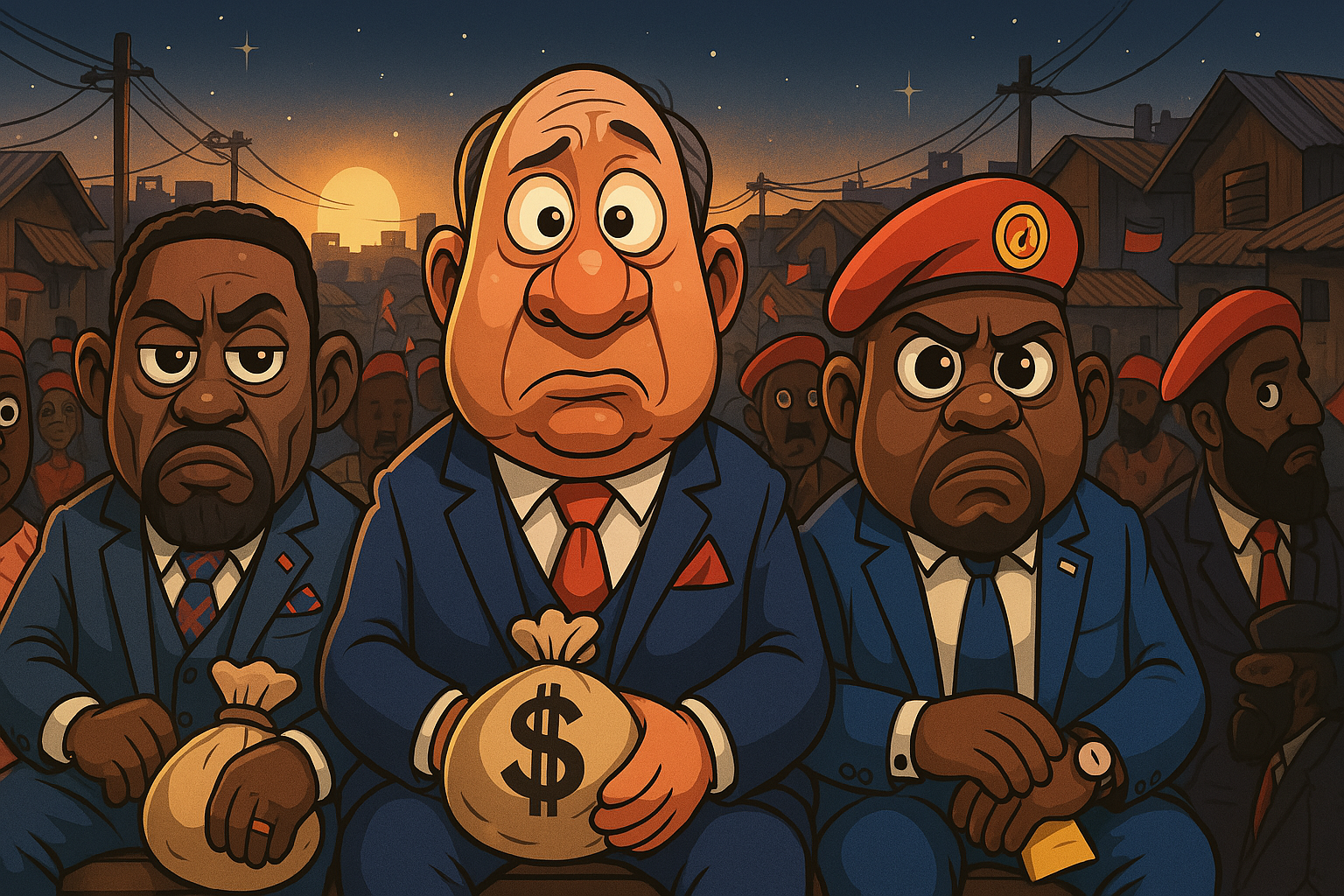 This is the core of the anarchist critique: the National Unity Platform (NUP) is not an alternative to the National Resistance Movement (NRM); it is a rival gang. It operates on the same top-down, authoritarian model. The recent outrage over denying Saudah Madaada a party flag is not a betrayal of principle; it is the standard practice of any hierarchical organisation that prioritises centralised control and electoral calculous over genuine grassroots power. They are not revolutionaries; they are managers-in-waiting, auditioning for the role of presiding over the same oppressive state apparatus.
 In this model, a “revolutionary” is not someone with a famous name, but anyone who participates in building this new world. Their work is anonymous, collective, and powerful.
 This is the work that builds real, autonomous power from below. It makes the state and its opposition increasingly irrelevant.
 The real struggle for Uganda’s future is not happening in the party headquarters or the parliamentary committees. It is happening in the everyday acts of solidarity and autonomy where Ugandans are taking power back for themselves. The Titanic of the Ugandan state is indeed sinking under the weight of its own corruption and violence. The anarchist imperative is not to rearrange its deckchairs, but to build a fleet of lifeboats capable of sailing towards a new horizon, leaving the doomed vessel—and all those squabbling on its deck—behind.
 This is the process of dissolution. It doesn’t storm State House; it slowly empties State House of all its power and meaning by creating a society that simply no longer needs it.
 This ensures the movement remains accountable to the people it claims to represent, not to shadowy donors.
 This is the “wisdom in the home.” It is practical, empowering, and it works. It builds confidence and demonstrates that the people do not need the state to survive and thrive.
 This cycle of hope, venting, and managed betrayal is a safety mechanism for the regime.
 The task for genuine radicals is not to fight for a looser leash or a more beautiful necklace. It is to slip the leash entirely. This means recognising the state’s political theatre as a distraction and turning away from it. It means redirecting all that stolen energy, all that passion and anger, into the quiet, dogged work of building community power from the ground up. The real struggle for Uganda’s future is not happening on the campaign trail or in the courtrooms; it is happening anywhere Ugandans are organising themselves, freely and without permission, to take control of their own lives. The regime can manage an opposition party; it cannot manage a people who have decided to become ungovernable.
 The real struggle is not defined by who shouts the loudest from the farthest away, but by those who, together, endure the heat of the flames and are collectively building the new world from its ashes. The ultimate revolutionary question is not “What do I have to say?” but “How can I be of use?”. For the exile, answering that question honestly is the first step back towards genuine relevance.
 This is solidarity forged in shared struggle, not in sentimental language.
 The task is to stop building movements based on identity and start building power based on class interest and direct action. We must create organisations so powerful and united that the monitor lizard finds no cracks to exploit, and instead meets a solid, impenetrable wall of collective resistance. The goal is not to get a few more women into parliament; it is to abolish parliament itself and replace it with a world where all people, in all their diversity, are free.
 The elite melodrama makes these classes invisible. Their daily struggle for survival is not considered “politics”; it is merely background noise to the main event in Kololo.
 The real struggle is not between Bobi Wine and Museveni. The real struggle is between the oppressor class (the state bureaucrats, military elite, and their capitalist partners) and the oppressed classes (the workers, peasants, and urban poor of all tribes and genders). The former’s power depends on the latter’s disunity and disorganisation. The revolution will not come from a new party card. It will come when the erased classes stop waiting for a saviour and begin to build their own power, recognising that in their collective hands lies the ability to stop the country and build a new one from the ground up. They must stop being the audience to the elite’s drama and become the authors of their own history.
 In this model, power is distributed horizontally. Society is managed by the people themselves, through recallable delegates and federated councils, not by a president or a parliament.
 The true revolutionary task is not to campaign for a new president, but to organise our communities to be self-sufficient and defiant. It is to build a world where the president, the parliament, and the very state itself are rendered obsolete by the power of the people organised from below. We must not seek to hold the leash. We must break it, and in doing so, declare that no one will ever need to hold it again.
 The real struggle is not on the television screen; it is in the cost of your child’s meal, in the threat of eviction over your home, and in the shakedown by the local official. This is where the state makes itself known, and this is where it must be confronted and defeated. Stop discussing the party’ drama. Start organising your neighbourhood. The power to change Uganda does not lie in the NUP headquarters; it lies in your compound, on your street, and in your willingness to act together with your neighbours. That is the only struggle that matters.
 The anarchist alternative is to embrace the fight. This means rejecting the identity of victim and claiming the identity of a protagonist. It means stopping the wait for a leader to recognise your pain and starting the work of building collective power with your neighbours. The real memorial to those who have suffered is not a tearful press conference; it is a well-organised community that is capable of ensuring that such suffering cannot be inflicted so easily again. True honour lies not in displaying your wounds, but in ensuring no one else receives the same.

Conclusion: Smashing the Idol of the Party
A powerful Runyankole adage distils a fundamental truth about self-determination: “Engundu etarimanya, yengyerwa omu maisho.” (The monitor lizard that does not know itself is led by the mirror). It speaks to a creature so captivated by its own reflection that it is lured to its capture or demise. This is the precise condition of Uganda’s political opposition. The weeping and gnashing of teeth over Saudah Madaada’s political career is a symptom of a society that has been taught to be captivated by its own reflection in the mirror of elite politics—to look for saviours in palaces and parliament buildings, rather than to recognise its own power. The National Unity Platform (NUP), the Forum for Democratic Change (FDC), and their celebrity activists are not the solution; they are the mirror. They are part of the architecture of the problem, sustaining the debilitating myth that our oppression is a result of bad individuals, not intrinsically bad systems.
The anarchist analysis reveals this spectacle for what it is: a tragic diversion. True revolution is not about which politician gets a flag or which activist gets a uniform. It is not about replacing the manager of the plantation. It is about the silent, relentless, and unglamorous work of burning the plantation down and sowing new seeds in its ashes. It is about building dual power: creating our own communities, our own economies, and our own means of defence that operate completely outside the control of the state and its rival gangs. It is in the Olukiiko lwa Bantu (people’s assemblies) under the mango tree, in the syndicates of workers and market vendors, and in the mutual aid networks that ensure no one starves, that the real Uganda is being forged. This praxis recognises that the power of the landlord, the police officer, and the corrupt official is not monolithic; it can only be broken by the organised, direct force of the people they exploit.
Let the NUP and Stella Nyanzi have their drama. Let them weep over their flags and design their uniforms for the rejected. The real struggle for a free Uganda—a stateless, classless, decentralised Uganda—is happening elsewhere. It is happening in the communities of Apaa that physically resist eviction, in the groups of youth in Kisenyi that organise food shares during lockdowns, and in the minds of those who finally realise that no one is coming to save them, and that they must, through collective action, save themselves.

The only flag worth fighting for is the black flag of anarchism—a flag that represents no nation, no party, and no master. It represents a future of free federation, where power is not a trophy to be won in Kampala, but a daily practice exercised by everyone, everywhere. It is the flag of a people who have finally stopped looking in a mirror held up by their oppressors and have instead recognised their own formidable strength. The monitor lizard has finally seen itself, and it is ready to fight.
Sub delegate
Joram Jojo
- Managed Opposition: How Museveni’s Regime Uses the NUP to Control Dissent - 4th September 2025
- Military Courts vs Civilian Justice: Key Issues in Uganda’s UPDF Amendment Bill 2025 - 17th May 2025
- Yoweri Museveni vs. Bobi Wine—A Tale of Two Dictators - 31st March 2025
RELATED PUBLICATIONS:
 Yoweri Museveni vs. Bobi Wine—A Tale of Two Dictators
 ROBERT KYAGULANYI, AKA BOBI WINE IS A SCAM
 BOBI WINE DIDN’T RUN A POLITICAL CAMPAIGN FOR A UNITED UGANDA
 BOBI WINE HAS HIGHJACKED THE NATIONAL UNITY PLATFORM
 BOBI WINE AND HIS GANG ARE FAKE LIBERATORS
 UGANDA ELECTORATE REJECTED THE BOBI WINE CALIPHATE
 INFIGHTING BETWEEN THE NATIONAL UNITY PLATFORM
 THE UGANDA NATIONAL UNITY PLATFORM PARASITES
 PARASITIC POLITICS AND PUPPET POLITICIANS IN UGANDA
 ASSAULT ON JOURNALISTS BY THE NATIONAL UNITY PLATFORM (NUP)
 DR. JANE RUTH ACENG IS A HEALTH HAZARD
 No UPC Member has Joined National Unity Platform party (NUP
 POLITICAL CON ARTIST JOEL SSENYONYI FORGETS TO LIMP
 ERIAS LUKWAGO IS THE MOST USELESS MAYOR
 POLITICIANS HAVE GANGED UP AGAINST UGANDANS
 NUP CITY HALL COUNCILLOR ARRESTED FOR BRIBERY
 Kisoro Elections: Democracy, Minority Rights, and the NUP’s Showbiz Struggle